Ideas developed from the author’s original article
From Broad Concepts to Operational Definitions
The debate around “ultra-processed foods” (“UPFs”) is entering a new phase. At the end of 2025, The Lancet published a 3-paper series on “UPFs”, covering health associations and policy recommendations1.
Much of the evidence underpinning this classification comes from observational studies that rely on dietary assessment methods not originally designed to assess food processing2.
While these studies identify associations between dietary patterns and health outcomes, they do not establish cause and effect or determine the independent contribution of specific ingredients to the observed associations.
One of the most significant developments from the Lancet paper series was the proposal of moving beyond the broad descriptive Nova classification by Monteiro et al.3 toward a more operational definition based on “markers of ultra-processing” (MUPs).
These MUPs tend to include ingredients and additives not generally used in home cooking. In practice, however, they also represent a subtle but important shift in how “UPF” is being conceptualised.
The discussion implicitly moves away from processing towards ingredients and formulation-level classification systems capable of being applied at product level and at scale.
This distinction matters because it means there are more questions to be answered such as which classification system is being applied, how is it operationalised, and what happens when it is used across real-world datasets.
These questions reflect a broader transition taking place across nutrition policy, where the conversation is increasingly focussed on data infrastructure, challenges, opportunities and implementation of health metrics.
The Lancet UPFs series1 expands upon the related literature by moving from a classification widely used in observational studies to a definition that can be applied in practice for policy purposes.
Yet, at the time of writing this article, these ingredient-level approaches have not been empirically tested against health outcomes.
Existing Policy Landscape Remains Primarily Nutrient-Based
Despite growing policy and scientific attention on food processing levels, most regulatory approaches for enabling healthier food choices (e.g. taxation, marketing restrictions, labelling) still operate primarily through nutrient-based thresholds.
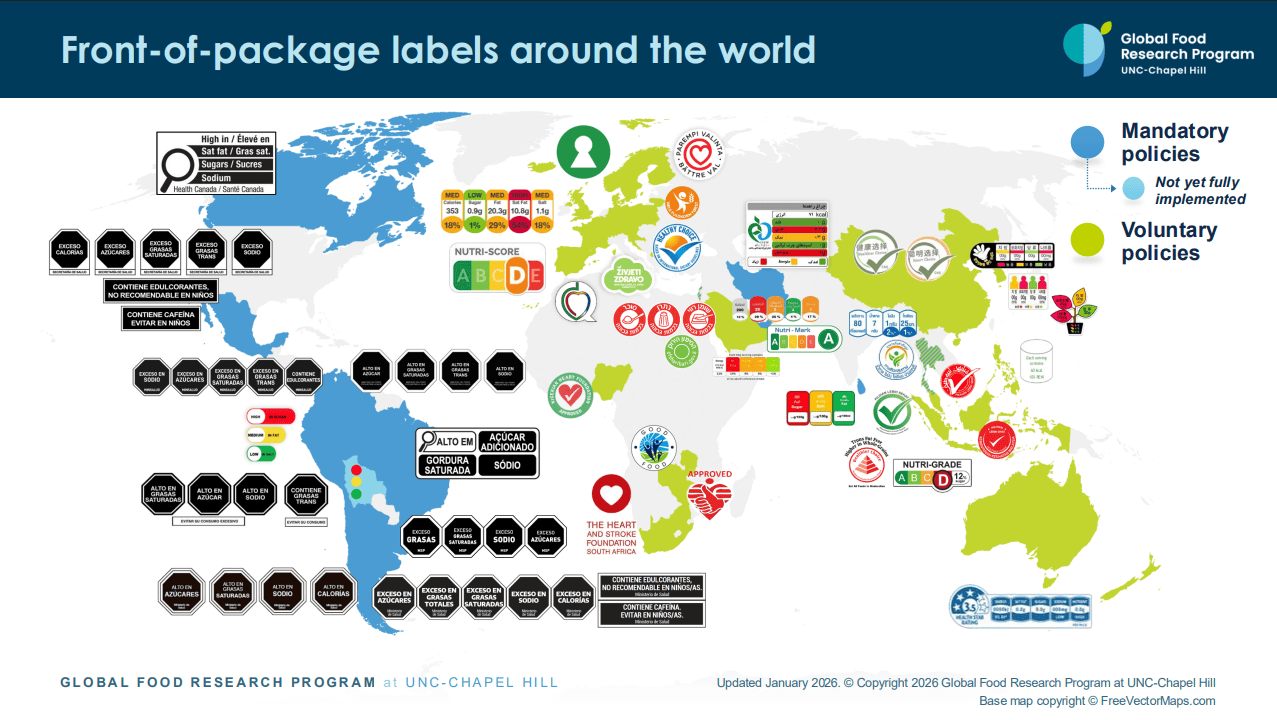
© Copyright 2026 Global Food Research Program at UNC-Chapel Hill. Base map copyright © FreeVectorMaps.com
Front-of-pack warning labels in countries such as Chile and Mexico focus on nutrients of concern and, in some cases, sweeteners. Restrictions in the UK on products high in fat, salt, and/or sugar (HFSS) rely on a nutrient profiling model.
Similarly, the Nutri-Score in certain European countries evaluates products through nutrient composition for labelling. China requires sugar and saturated fat labelling and health warnings for children for mandatory implementation in 2027.
Although these systems do not classify foods according to their level of processing, food processing and ingredient-level definitions are now being considered in discussions around dietary guidance, marketing restrictions, taxation and/or front-of-pack labelling.
As these policy approaches use different underlying criteria, this raises an important question: what additional value does classifying foods by their level of processing provide beyond existing nutrient-based systems?
The Rise of Ingredient-level Classification
The proposed MUPs approach attempts to create a more scalable and standardised way of identifying “UPFs” using ingredient list data. In theory, this allows classification to be applied consistently across large manufacturer and retailer datasets, but it also raises unresolved questions within the food processing debate.
One question is whether regulation is ultimately targeting specific ingredients or foods as a broader category. Discussions often move interchangeably between emulsifiers, stabilisers, sweeteners, flavourings, industrial formulations and processed foods themselves, despite these not necessarily representing equivalent policy targets.
Another challenge relates to evidence translation based on the available science to date. As a result, it leaves a gap between the descriptive categories used in dietary surveys and ingredient-level systems proposed for regulatory implementation.
The growing shift toward ingredient-level operationalisation therefore changes the nature of the debate. At the same time, implementation remains inherently difficult.
Currently, there is no globally harmonised MUP framework, raising practical questions around who determines the official list of markers, how lists are updated and how disagreements are resolved as (re)formulation practices evolve.
Emerging Attempts to Bridge the Implementation Gap
In May 2026, Healthy Eating Research (HER) convened an expert panel to evaluate existing UPF definitions and approaches for guiding policy development4. The report acknowledged that processing alone is not sufficient to determine the overall healthfulness of foods and instead is as an additional lens that may complement existing dietary assessment approaches.
In addition, inclusion of specific markers is not necessarily because those ingredients are individually harmful, but because they are viewed as indicators of foods categorised as “ultra-processed”.
However, while broader dietary patterns classified as “UPFs” may have been associated with adverse health outcomes in observational studies, it remains unclear whether the proposed ingredient-level markers used for policy capture those same associations.
The HER panel brought practical implementation challenges into sharper focus. These included maintaining and updating ingredient databases within rapidly evolving food supply chains, ensuring sufficient transparency around formulation practices, and managing the reality that static marker lists may quickly become outdated.
At the same time, the project reflects expansion of the field by applying proposed metrics to more than 90,000 products, highlighting how food classification systems need to consider real-world data to understand policy implications.
Reformulation and Shifting Incentive Structures
One of the most important implications of ingredient-level approaches relates to reformulation incentives. The Lancet series critiques nutrient reformulation by arguing that reductions in fat, salt and/or sugar may increase the use of additives or industrial ingredients.
Yet ingredient-level operationalisation could itself create a different set of reformulation incentives, which may take the form of optimisation away from “less sugar” towards “less emulsifier”, expanding previous trends on “clean(er) label” or “natural” ingredient substitution strategies.
If ingredient-level criteria become the primary regulatory gatekeeper, reformulation may lead to prioritisation of additive substitution and formulation optics over measurable nutritional improvements.
This creates a broader policy question: what exactly is regulation trying to incentivise – nutritional composition, degree of processing, category restrictions, ingredient familiarity, formulation simplicity, eating behaviour, or some combination of these factors?
California as an Emerging Real-World Test Case
A number of these tensions are now beginning to materialise in regulatory approaches.
California has become one of the clearest examples of attempts to operationalise the level of food processing within legislation. In 2025, the state introduced a formal “UPFs” definition for school food restrictions through AB 1264. More recently, AB 2244 proposed applying this classification through a certification scheme for non-“UPFs” and preferential retail placement for certified products.
Rather than relying solely on Nova categorisation, California’s approach combines ingredient-level markers with nutrient thresholds. Products may be classified as “UPFs” if they contain one or more listed additives while also exceeding thresholds for saturated fat, added sugar or sodium. However, products containing non-nutritive sweeteners or polyols may still fall within the definition even where nutrient thresholds are not exceeded.
The result is a system where HFSS does not always equal “UPFs”, and vice versa, which creates potential divergence. Nutritionally poor products may avoid “UPF” classification through “natural” substitutions, while products that have improved nutritionally may remain within restricted categories because of ingredient composition.
Alongside policy-led approaches, a growing number of third-party certification schemes have also been developed, particularly in the US, to certify foods as non-“UPF”. These schemes often apply different criteria and thresholds, further illustrating the fragmentation currently emerging within operational definitions.
Product-Level Data is Becoming Central
One of the clearest changes emerging is that the debate is moving beyond a single classification and increasingly overlapping with wider discussions on data infrastructure.
Policy impact ultimately depends not on whether a classification system appears coherent theoretically, but on what happens when it is applied across real-world products, retail environments, purchasing and consumption datasets.
A framework may appear conceptually robust yet generate unexpected divergence, inconsistencies or implementation challenges once operationalised at scale.
Questions around ingredient transparency, data access, and successful implementation are therefore becoming central to the future of food and nutrition policy.
Final Reflections
A key challenge for “UPFs” moving forward is considering where the concept genuinely adds value beyond existing policy approaches. Most stakeholders working in this space ultimately share similar goals: supporting healthier and more sustainable diets.
However, before “UPF” becomes embedded within regulatory frameworks, there needs to be greater clarity around what the concept is intended to achieve and whether current operational approaches remain coherent when applied consistently across real-world food systems and datasets.
Whatever direction the conversation takes, the future of “UPFs” feels likely to become more data-led, not only “definition-led”. As such, the next chapter may depend less on continuing debates around classification itself, and more on understanding what happens when these approaches are applied in practice.
Without this, there is a risk that unintended consequences and potential divergence beyond existing nutrient-based approaches remain poorly understood, particularly as regulatory development in this area continues to accelerate.
What Do Emulsifiers Do in Food?
Emulsifiers in food are used to improve quality or shelf life through strengthening dough in baked goods, stabilizing foams, preventing food from getting stale, or making foods more freeze-thaw stable.
They can be derived from a range of products like soy and sunflower lecithin to propylene glycol alginate. Emulsifiers can bind to two liquids that usually do not mix well together.
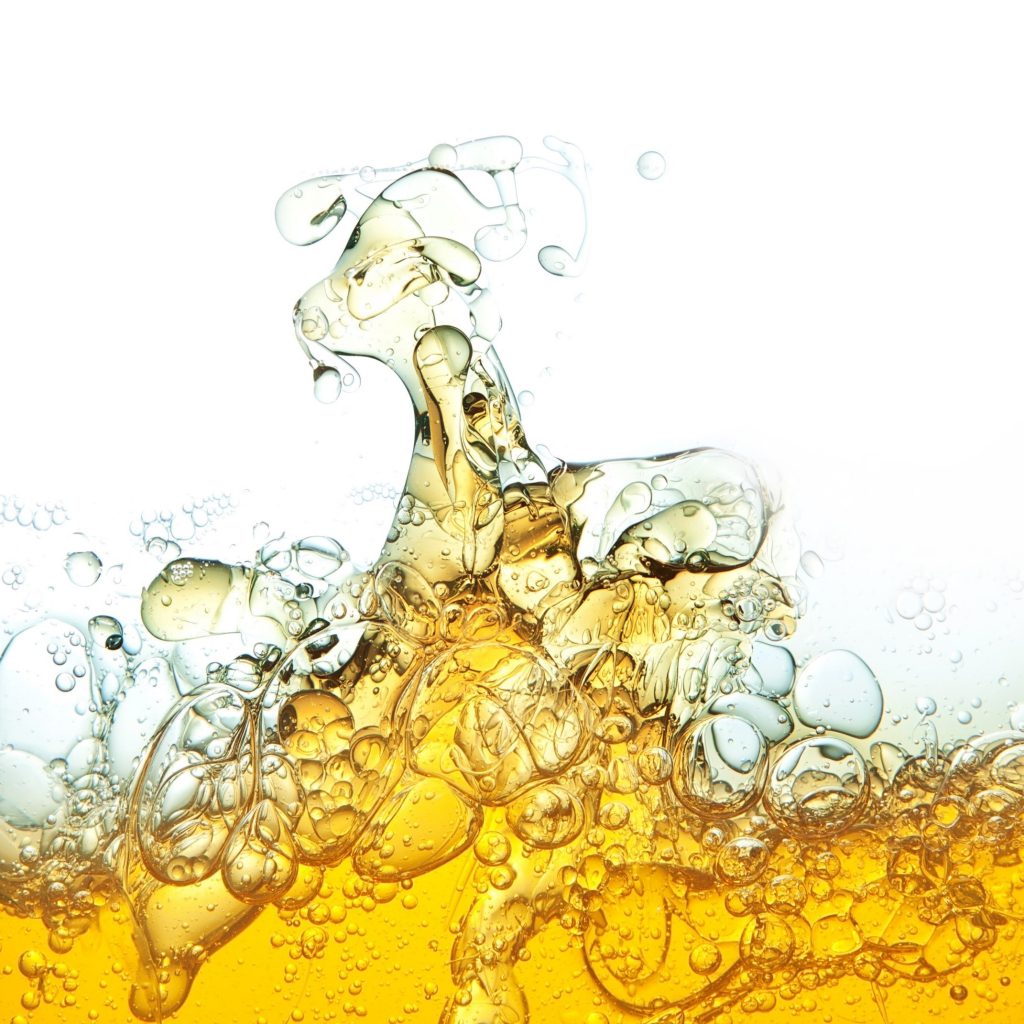
A traditional example is mixing (or rather, trying to mix) oil and water. These fluids don’t like to mix because of their chemical properties. This is where an emulsifier comes into play.
Emulsifiers have water loving (hydrophilic) and oil loving (hydrophobic) regions that allow the two immiscible ingredients like water and oil to join. Therefore, emulsifiers in the product keep all of the liquids mixed smoothly.
In the continuing age of decreasing the amount of food additives, it is important to understand why some of them are utilised so heavily in the food industry.
Emulsifiers and their function in food allow the consumer to view their food in a consistent, smooth and quality manner.
Prior to the addition of an emulsifier like mono- and diglycerides to a product, it would need continuous mixing to prevent the oil and liquid phases from separating.
Food manufacturers add these ingredients to ensure a standard product across the board and to make it more convenient for consumers to use, ultimately saving time.
What Foods Contain Emulsifiers?
Baked Goods
Cake, yeast raised goods like doughnuts, icing, filling, bread and specialty cakes all utilise emulsifiers. When these baked goods lack emulsifiers they show quality defects and negative sensory attributes including tough, dry, stale or tasteless (Brandt 1996).

On top of the negative sensory attributes associated with baked goods, without emulsifiers, shelf-life is also reduced. So what do emulsifiers do in these delicious treats?
The answer is the same things eggs do when added to baked recipes, since the lecithin in egg yolks acts as an emulsifier.
Emulsifiers help the shortening ingredient in the dough of baked goods perform better.
Emulsifiers do this by improving tenderness, flavour release, volume, water absorption, texture and reduces the use of egg, shortening and mixing time (Orthoefer 2008).
Emulsifiers in baked goods not only increase positive sensory attributes in terms of flavour and texture, but also lend a hand in the sustainable movement.
They keep baked goods fresher for longer, thus reducing the amount of food waste.
Dairy Products
To support the stability and texture of dairy products including ice cream and processed cheese, the use of emulsifiers is necessary.
In ice cream, emulsifiers are used because the ice cream whips easier, does not melt as fast on a hot sunny day, has a smoother body and texture and the air particles within the ice cream are more uniformly spread across (Euston 2008).
In processed cheese, the final water content can go up to 58% water and around 15-25% fat (Euston 2008). The large portion of immiscible liquids within this product make it nearly impossible for this product to be made in a uniform and consistent manner without the use of emulsifiers, specifically emulsifying salts.
Infant Formula
When it comes to emulsifiers found in children’s infant formula there are two types, one protein-based and another non-protein based (McSweeney SL 2008).
Various by-products of bovine milk including skim milk powder, milk protein isolate, whey protein concentrate and more are considered the protein based emulsifiers. These emulsifiers work well due to their amphipathic (water and oil loving regions).
The non-protein based emulsifiers including lecithin, mono- and di-glycerides, citric acid esters of mono- and diglycerides of fatty acids and more are the main emulsifiers in infant nutritional foods (McSweeney SL 2008).
Both types of emulsifiers are utilised to improve the stability of products and help form a stable emulsion. The addition of these ingredients will help prevent defects including:
- Oiling off – Oil appearing on the surface of the infant product
- Creaming – Upward movement of droplets caused by gravitational force
- Sedimentation – Downward movement of droplets from having a higher density than the surrounding liquid
- Ringing – A white ring at the top of a container and
- Water and oil separation (McClements 2016).
Although these defects are a concern of quality and not of safety, observing these defects in an infant’s formula on a consistent basis would cause the consumer to think twice about purchasing these products.
Emulsifiers are there to ensure defects like the ones above do not occur and to make sure every ingredient is suspended in the food matrix uniformly.
Emulsifiers are there to improve and maintain the way consumers view their food while extending the shelf life of various food products.
What Are Examples of Emulsifiers in Food?
Table 1 shows examples of common emulsifiers, where they are found and what they do in that food or beverage.
Table 1. Emulsifiers and surfactants used within the food industry to decrease unfavourable sensory characteristics. (Reproduced from Hasenhuettl 2008)
Consumers are constantly on the lookout for more natural emulsifiers due to negative press emulsifiers have received over the years.
Some fibres, like gums, are used as emulsifiers while also providing fibre content and prebiotic benefits for gut health.
These may provide a solution as consumers seek to avoid more synthetically based emulsifiers.
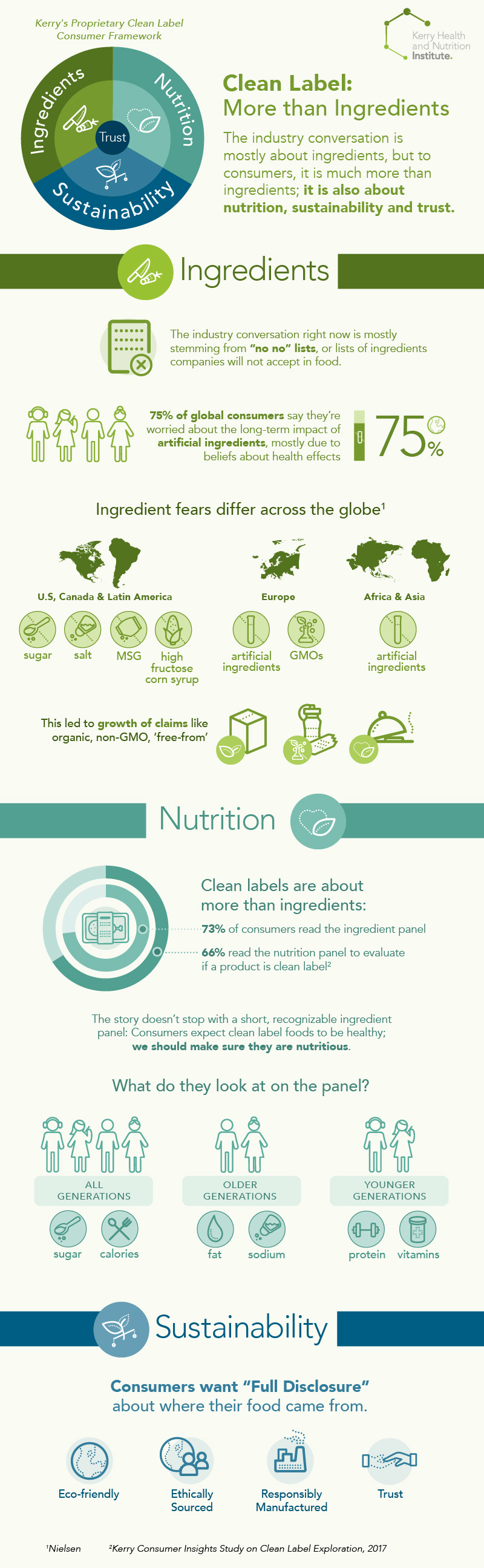
Conscious consumers want to feel that a food or beverage aligns with their beliefs, which has led to a push for claims like ‘free from artificial colors or preservatives’, ‘organic’, and ‘made with natural ingredients’.
Consumers who seek foods that they perceive as natural and healthy don’t offer the industry a consistent definition of what they accept on product labels – simply put, they expect food as it should be.
Consumer research helps us to group the main categories of what consumers are looking for when it comes to ‘clean label’, trustworthy foods: ingredients, nutrition and sustainability. 84% of American consumers are seeking more natural and less processed foods.
At the same time, foodborne illness is the #1 food safety concern for consumers, rising above issues like chemicals or food additives (International Food Information Council, 2019), so as the food industry tries to meet these demands, they are faced with the challenge of finding the balance between convenience and safety, while also offering foods that are as close to homemade as possible.
When we decode consumer demands, we may find ourselves layering in challenges that consumers care about, but have not even considered.
For example, natural foods create challenges surrounding:
- Food waste
- Food safety
- Food appearance
Balancing Food Waste and the Movement Towards Natural Foods
Natural homemade foods made with locally-sourced kitchen cupboard ingredients are the standard narrative targeted by many consumers – unfortunately they have a very short shelf-life.
Consider a homemade loaf of brown bread, it typically becomes stale within a few days and may develop mould within a week. The perceived premium homemade quality helps offset the limited shelf-life, making its freshness part of its appeal.
However, the short lifespan of homemade foods can sometimes create a sense of obligation to eat them before they spoil rather than simply enjoying them.
The same emotional consumer journey does not translate for purchased food with natural positioning, which usually comes at a premium.
When the consumer realises that the shelf life of natural food is inconvenient and doesn’t fit into their busy lifestyle, there is a negative association with the money wasted and the pressure not to let the product go to food waste.
The intent to repurchase is diminished due to the inconvenience of wasting a premium food product or having to shop more often to accommodate a product’s short shelf life. One-third of food globally goes to waste and this rises to 40% in North America.

Consider store-bought bread. Across the US and Europe, bread has the highest volume of waste but is generally a low value product.
The solution is to look to naturally-derived methods of maintaining shelf life that meet consumers’ label and ingredient expectations that can be scaled up to create commercial solutions. Like adding lemon juice to fruit salad or rinsing fresh berries in vinegar, a combination of traditional methods and scientific studies can be used to solve these challenges. In bread for example, sourdough (fermented wheat flour) is an authentic shelf life solution.
The Food Safety Problem
The number one claim in new product launches across many categories is “No Additives/Preservatives”(Mintel GNPD).
Consumers want ingredients which they can understand and trust, but at the same time hold food safety as a top priority.
In the meat category for example, there is a distinction between fresh meat whose appearance and freshness is key and which must be handled and cooked correctly by the consumer.
Consumers will scrutinise the source, freshness and appearance of fresh meat more than any other category.
Processed meats are highly regulated by bodies such as USDA for pathogen control to ensure food safety over shelf-life.
As consumers reject traditional preservatives, the industry must look to nature for solutions that help them to meet consumer demands without compromising food safety.
Consumers are not willing to risk their family’s safety by feeding them preservatives, but equally, they are not willing to risk food poisoning for the same cause…

We see that meat brands who can find the balance with the removal of artificial preservatives but meet consumer shelf-life and federal food safety regulations see growth in an otherwise stagnant market.
With a range of natural shelf life options such as extracts, fermented vegetable juices, functional flavours and vinegar becoming more accessible globally and being backed by challenge and shelf life studies, there are options for brands looking to reformulate for health and wellness.
For more information on how these solutions work, read the article Fermented Ingredients for Natural Preservation.
The Aesthetics of ‘Natural’ Food
Consumer awareness of the natural appearance of certain foods can vary by region and education. For example, tarama (a Greek meze made from fish roe) is naturally beige/grey, but the French market has been conditioned for it to appear pink as a sign of quality.
When confronted with the highest quality natural product, consumers are concerned that it has spoiled due to the unfamiliar colour.
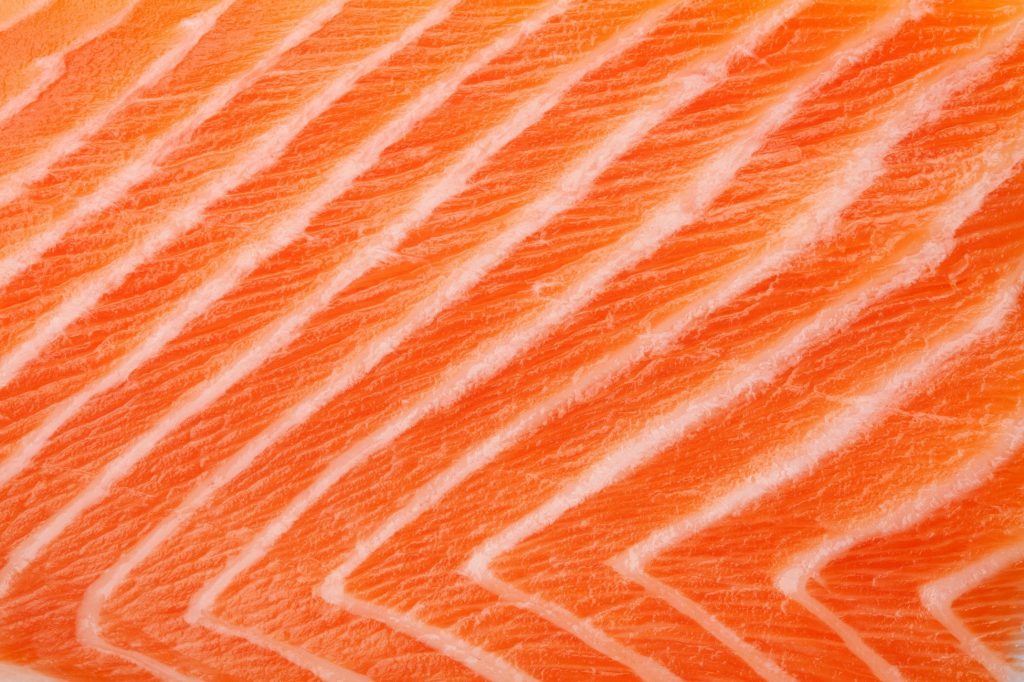
Wild salmon may be white, depending on its diet or ability to process certain pigments. The deep red colour comes from pigments in crustaceans in the salmons’ diet.
Farmed salmon is fed compounds to give it the familiar orange colour. Both of these are additives of sorts but they are unconsciously demanded by consumers through conditioning to recognise colour as a sign of quality.
Turkey deli meat is another example. In the US, to meet shelf life demands, it is often cured with sodium nitrite or natural alternatives for pathogen control.
The resulting turkey deli meat carries a lot of the colour and flavour characteristics of ham, so many times the turkey flavour and appearance need to be built back in. Consumers confronted with whiter turkey deli meat may wonder if it is bleached, or bland in comparison to what they are used to.
Like has been done in recent years in other categories with claims such as “naturally cloudy” in apple juice, “natural sediment may occur” in craft beer or “separation is natural, stir me up” in natural nut butters, we must find ways to reassure consumers who may be surprised by the natural appearance of certain foods.
The Future of ‘Natural’
In short, consumers want it all and they want it now…but they don’t always understand what they are asking for. Science-backed innovation in this novel foods space is ongoing, gaps still exist to allow manufacturers to reduce packaging and maintain quality with naturally-derived processes and ingredients.
Market solutions need to be backed with food safety data and assessed as GRAS (generally recognised as safe) by regional bodies such as EFSA and the FDA for safety of new substances or new proposed uses for currently authorised substances.
As the industry moves towards greater transparency, there is an opportunity for consumer education to ensure products developed meet their unexpected expectations.
To watch our webinar on Clean Label: More Than Ingredients click here.
Summary
 Healthy eating has never been more talked about, and the ‘free-from’ trend has been dominating the consumer marketplace.
Consumers are increasingly demanding foods that are free from allergens like gluten or dairy, artificial ingredients like flavours and preservatives, and any ingredients with unfamiliar names.
The response of the food industry to this booming consumer demand is a ‘Clean Label’ movement.
Food and beverage manufacturers in every category and channel are innovating and evolving to stay ahead of these changing consumer needs by reducing the number of ingredients on labels, removing unfamiliar ingredients, and building trust with consumers.
To consumers, though, it is about more than a clean ingredient label. Join us for a webinar which looks to the future of healthy eating and the impact on the food industry.
See why cleaner labels may just be part of a solution for an expanded consumer definition of health, and why nutrition, social and environmental responsibility will be key to successfully meet long-term consumer needs for healthy food.