The United States (US) releases new dietary guidelines every five years. It is a formal process, involving an expert committee, several meetings and opportunities for public comments.
These guidelines are published jointly by the department of Health and Human Services (HHS) and the US Department of Agriculture (USDA) and are long considered an authoritative source on health and nutrition guidance in the US.
These guidelines have several roles:
-
- To help Americans choose a healthful diet.
- To advise nutrition standards for a wide variety of federal feeding programmes like the school lunch programme, the Child and Adult Care Food Programme and the Supplemental Nutrition Programme for Women, Infants and Children (WIC).
- To support federal and other public health nutrition education programmes.
- To support food fortification and reformulation efforts by the food industry.
So why have these latest guidelines, published in January 2026, received so much attention?
The New Dietary Guidelines – a Significant Reset?
These 2025-2030 Dietary Guidelines for Americans (DGA’s)1 are promoted as the “most significant reset of federal nutrition policy” and highlight the placing of “real food at the centre of the American diet.”
However, much of the guidance has remained the same with a focus on eating nutrient dense foods, limiting added sugar and keeping saturated fat intakes below 10% of calorie intakes.
What is different is the emphasis on certain foods and nutrients, the new inverted food pyramid and how the process was undertaken this time around.
These guidelines are posted on a website including supplemental materials and Grok AI to answer consumers’ questions2.
Key differences in messaging in the 2025-2030 Guidelines:
Here is a quick look at some of the differences in the new guidelines compared to the previous version:
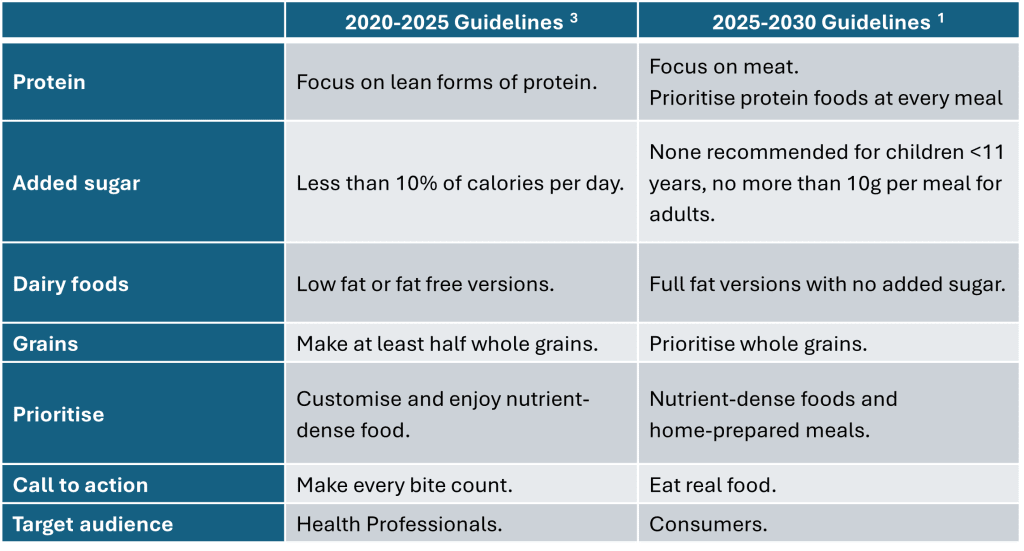
Increased Protein: Americans have long consumed more protein than earlier dietary recommendations advised. However, the new dietary guidelines declare an end to the “war on protein”2 and to prioritise protein at every meal.
They substantially increase the suggested intake to 1.2–1.6 g/kg/day for all Americans, rather than recommending increased intakes for specific subpopulations as in the past.
Meat and other animal-based forms of protein are highlighted in the guidance, with an acknowledgement that one can also find protein in other foods like beans, lentils, tofu and nuts.
Previous editions of the DGA’s and other substantial dietary guidance from around the world highlight the importance of using plant-based protein sources for sustainability and health reasons4.
Additionally, meat and animal-based protein tend to be more expensive than plant-based proteins and the costs associated with these changes are a limitation for many Americans.
Saturated Fat-Containing Foods: These dietary guidelines maintain the previous recommendations to limit saturated fat to less than 10% of calories.
However, these guidelines suggest consuming butter, full-fat dairy products, beef tallow and eating more meat.
Based on the recommended number of servings for these foods, remaining within the 10% saturated fat limit will be a challenge5.
Define Real Food: One of the main messages of the 2025-2030 guidelines is to “Eat Real Food”. These guidelines steer Americans to consume foods like meat, full fat dairy products, fruits, vegetables and whole grains as the real foods, with a strong focus on the meat and dairy product categories.
While there have always been recommendations to consume nutrient-dense foods, these guidelines suggest limiting highly processed foods, implying these do not count as real foods.
Highly processed foods (often referred to as ultra-processed foods (UPF)) are under scrutiny around the world to determine definitions and health effects, but the science is far from settled.
In the guidelines, little guidance is provided on how to make such a substantial change – how to remove highly processed foods from American’s diets and to shift to lower processed foods.
Added Sugars: The new recommendations are stricter, limiting added sugars to no more than 10g per meal for adults and no added sugars before the age of 11 years. They also suggest limiting non-nutritive sweeteners.
The guidelines do include detailed information on identifying added sugar and limits on how much added sugar should be included in snacks.
Sustainability and Equity: Throughout the world, countries and the Food and Agriculture Organisation of the United Nations (FAO) are focused on integrating the issues of sustainability and equity into their dietary guidance and food policies.
The later scientific committee behind the new DGA’s rejected these priorities in their substantiation documentation and they are not considered in these new guidelines6.
Reduce Alcohol But How Much?: As with the previous version of the guidelines, there is a recommendation that drinking less alcohol is better for health.
The difference is that the new DGA’s do not include any specific limits on how many drinks per day should be consumed.
Picture This Pyramid
One of the most visible changes of these dietary guidelines is the launch of a new image of the guidelines – an inverted food pyramid.
The US has not used a food pyramid since 2011 when the USDA switched to MyPlate to make it clearer how much of the plate should be filled with different categories of foods.
This new pyramid (Figure 1) showcases a wide top highlighting meat, cheese, milk and vegetables; with other proteins, some dairy foods, fats and fruit in the middle section; and whole grains at the bottom tip.
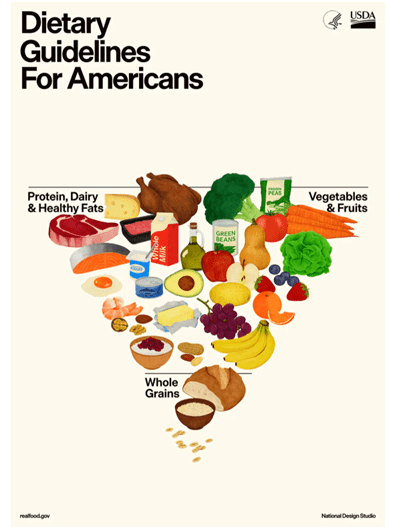
Figure 1. Dietary Guidelines for Americans 2025-20301
The number of servings for foods are not listed, nor are the food images shown to scale. Having whole grains displayed at the bottom tip may lead to consumer confusion as it suggests that very little grains should be eaten. However, the new guidelines still recommend 2-4 servings of whole grains per day.
Scientific Bodies Weigh In
Several expert public health organisations have responded to the new guidance. While they are positive about the elements of the DGA’s that align closely with the longstanding dietary guidance, they have also flagged concerns about some of the changes.
These concerns will likely impact on how the guidelines are adopted across the board by healthcare professionals, the public and the food industry alike.
The American Society for Nutrition’s (ASN) statement expressed concern over the change in the established scientific review process.
In 2023, a 20-scientist Dietary Guidelines Advisory Committee (DGAC) was selected, vetted for conflicts of interest and held public meetings before releasing a comprehensive scientific report in December 2024 with a public comment period7. Normally, this report would inform the final DGA’s.
However, a new group of nine scientists was contracted to produce The Scientific Foundation for the Dietary Guidelines. They rejected the results of the DGAC’s report and wrote this new document which was released along with the 2025–2030 Dietary Guidelines in January this year.
ASN believes the change from a rigorous and open process may undermine confidence in the DGAs and nutrition science and contribute to confusion8.
The Academy for Nutrition & Dietetics challenged the guidelines’ emphasis on animal sources of saturated fat, the lack of consideration of diets for people who cannot include dairy and the call for moderation in low calorie non-nutritive sweetener intake in the face of evidence that they are generally considered safe within acceptable intake limits9.
The American Heart Association says it will continue to “encourage consumers to prioritize plant-based proteins, seafood and lean meats and to limit high-fat animal products including red meat, butter, lard and tallow, which are linked to increased cardiovascular risk” pending any future research10.
The World Cancer Research Fund are concerned that the increased emphasis on red meat does not reflect the scientific evidence linking higher intakes of red and processed meat to increased cancer risk11.
Considerations for Food Industry and Healthcare Professionals
While the new DGAs are still in their early stages, it is possible to begin considering their potential impact. We know that dietary habits are notoriously resistant to change.
For two decades, the International Food Information Council (IFIC) Food & Health Survey 12 (an annual survey of 3,000 Americans) has consistently shown that taste dominates food and beverage purchase decisions, followed by price. These same factors will continue to play a crucial role in shaping the adoption of any new dietary guidance.
It is likely that consumers will encounter more mixed messages from both healthcare professionals and through social media.
The 2025 IFIC Food & Health Survey, showed that 8 in 10 Americans were confused over what nutrition information to believe in because they felt it changed frequently.
For this reason, it will be important to reassure the public that many elements of the new DGAs remain the same.
This is a key message that can be emphasised by both healthcare professionals and the food industry alike.
Food Industry
-
- Food companies will need to decide if they want to make changes to their portfolio based on the new guidance. Some change is already happening – one restaurant chain switched to cooking their fries in beef tallow13. However, it is early days and having spent years reformulating, food manufacturers may pause before making changes to their products’ recipes considering some of the conflicting evidence.
- The ambiguity around what defines a ‘highly processed food’ is difficult for product developers who are attempting to innovate or renovate but the DGA’s negative stance on “chemical additives”, added sugars and non-nutritive sweeteners, may accelerate the clean label trend and lead to shorter ingredient lists. While this trend creates opportunities for the food industry, food additives play an important role in food safety, preservation and in reducing food waste which remain priorities. Fortification with key nutrients often lacking in the US diet should not be abandoned for the sake of a shorter “clean label.” Companies that successfully balance these competing concerns may gain a competitive advantage.
- A recent poll found that 1 in 8 U.S. adults are taking GLP-1 medications for weight loss, diabetes or other conditions14. In response, the food industry is focusing on protein-rich, high-fibre, nutrient-dense foods. Notably, these priorities closely mirror the DGA’s; however, GLP-1 use often requires a more targeted individualised approach to manage appetite suppression, preserve muscle and prevent potential nutrient inadequacies that may not be wholly delivered through a focus on real foods alone.
Healthcare Professionals
-
- In the social media age, nutrition and dietetic professionals are well used to addressing conflicting advice but should expect growing confusion and challenge from both patients and other healthcare professionals.
- US federal food programme changes have traditionally followed lengthy rule-making processes, but healthcare professionals engaged in these programs should be ready for faster shifts under the current administration—for example, a recent law allowing whole and 2% milk in schools alongside skim and low-fat options was introduced15.
Conclusion
Ultimately, guidance alone does not result in positive dietary changes. Telling people to eat real foods does not work if they are unaffordable or unavailable.
The real question is whether these DGA’s will be followed by substantive federal action that enables Americans to make these changes in their daily lives.
Funding for educational programs to support healthy eating, reduction of food deserts in communities, cooking classes, reduced prices on food, support for improved food systems, funding for research and support for farmers to grow the diversity of crops needed are just a few of the actions required to support Americans to change their diets in such a large and profound way.