access
accessibility
accessible nutrition
A Global Look at the Lifespan-Healthspan Gap: Nutrition, GLP-1 and Access
19 FEB 2026
6 min read


 Feeding the world in a way that supports both people and the planet – without compromising the future – is igniting bold innovations for 2026 and beyond. Moving towards an industry where nourishing, affordable, and sustainable choices are within reach for everyone, everywhere.
In the eighth annual edition of the KHNI Health and Nutrition Megatrends, we explore the breakthroughs in science, technology, product development, and evolving consumer behaviours that are reshaping global food systems.
To build these insights, we collaborated with our extensive network of experts including food scientists, nutritionists, technologists, sustainability leaders, regulatory specialists, and members of the KHNI Scientific Advisory Council.
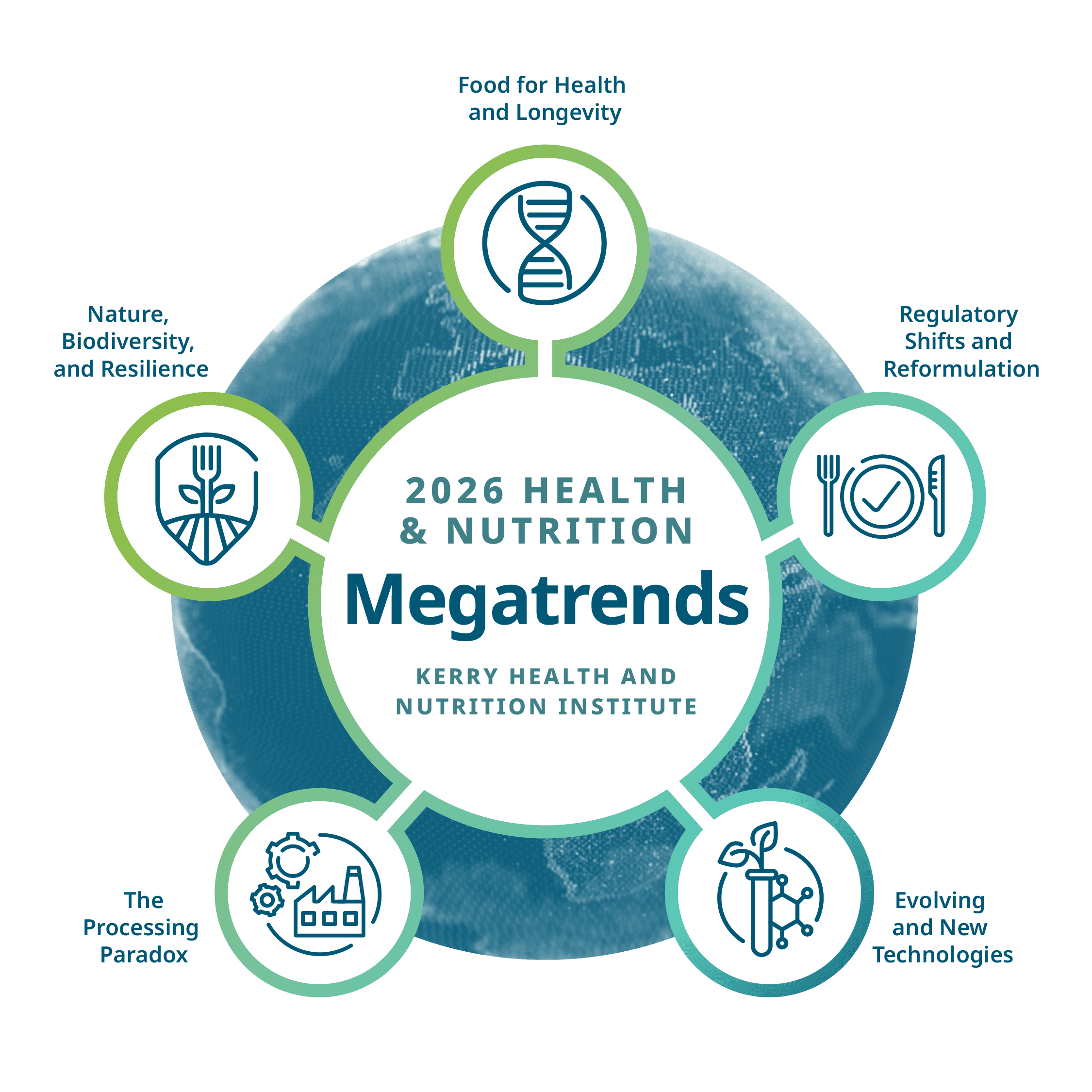
From this collective expertise, we identified five megatrends that are redefining the food and beverage industry, driving innovation in product design, formulation, and reformulation to meet the changing needs and expectations of consumers.
Healthspan is the new lifespan.
Living better is just as important as living longer.
How better nutrition is redefining what it means to age well.
The way we think about ageing is changing. It’s not just about living longer, it’s about living better. As global life expectancy climbs, adding life to years matters as much as adding years to life — and nutrition is right at the heart of that shift.
Nutrition equity is emerging as a global priority. With cost-of-living pressures shaping day-to-day choices, consumers want options that are not only functional, but genuinely accessible.
Mental, physical, and social wellbeing are increasingly understood as interconnected, which is pushing nutrition to evolve across multiple fronts such as supporting immunity, cognition, gut health, and sex-specific needs while responding to the growing influence of GLP-1s.
By 2030, one in six people worldwide will be over 60, and the rise of age-related conditions is accelerating demand for everyday nutrition that supports long-term vitality. From microbiome science to cognitive support and more personalised approaches to weight management, nutrition is widening its role in preventive health to help people add life to their years.
Key Areas Include:
Affordable Nutrition:
Cognitive Health:
Sex-Based Health:
Gut Health:
Immune Health:
Weight and Metabolic Health Therapeutics:
Expert Insights:
 “The convergence of physical, mental, and social wellbeing underscores a new paradigm in nutrition science – one that demands accessibility as much as innovation. Affordable, functional nutrition that supports immune, gut, and cognitive health is essential as we navigate the impacts of cost-of-living pressures and evolving health priorities.”
– Dr. Lisa Ryan, Head of School of Health, Sport Science and Nutrition, Atlantic Technological University Galway, Ireland.
 “Nutrition equity is rapidly becoming a global policy priority, not only because health is holistic – spanning mental, physical, and social wellbeing – but because glaring inequalities persist both within countries and among them, particularly across low- and middle-income countries. As cost-of-living pressures rise worldwide, people increasingly seek nutrition that is both functional and affordable. Addressing this requires integrated approaches across affordable nutrition, immune and gut health, cognitive health, sex-responsive solutions, reformulation, and responsible deployment of weight-management innovations such as GLP-based medications.”
– Professor Martin Bloem, Professor of Environmental Health, Johns Hopkins Bloomberg School of Public Health, Baltimore, USA.

The reformulation race is on.
Reformulation in a regulated future.
How policy is pushing a new era of reformulation.
Regulation is accelerating at speed, reshaping how food is formulated, labelled, and marketed. Governments are taking a more active role in improving public health, strengthening consumer trust and driving industry-wide reformulation toward more responsible, transparent products.
Front-of-pack nutrition labelling systems (FOPNL) — from Nutri-Grade (Singapore) to Health Star Ratings (ANZ) and traffic-light labels (UK & Ireland) — are fast becoming the global standard. Countries like Brazil, Mexico, and Colombia are setting the pace with front-of-pack warning labelling policies designed to support healthier choices and curb obesity and non-communicable diseases. As evidence of their impact grows, more regions are expected to follow.
These shifts align with a broader global push to modernise food-based dietary guidelines (FBDGs) prioritising both public health and planetary wellbeing. Governments are advocating for more plant-forward diets, tightening restrictions on the marketing of foods high in fat, salt and/or sugar (HFSS) — particularly to children — and expanding nutrient taxes that make reformulation not only encouraged, but economically strategic.
Momentum is building across the US through initiatives like Make America Healthy Again (MAHA), and across Asia-Pacific where sodium, sugar and saturated fat reduction targets are intensifying.
For the food and beverage industry, this landscape is both a challenge and a catalyst. Companies that move early with thoughtful reformulation, transparent communication, and sustainable product strategies will be best positioned to meet rising expectations and evolving public health goals.
Key Areas Include:
Regulatory & Policy Shifts
Reformulation
Expert Insights:
 “Across Latin America and globally, regulatory pressure and consumer demand are accelerating reformulation, which is no longer a checkbox – it’s a bold opportunity to reimagine food and beverage for a healthier, more sustainable future. As front-of-pack labelling, nutrient taxes, and policy shifts reshape the landscape, we have the chance to lead with creativity and purpose – delivering products that delight consumers while driving positive change for generations to come.”
– Dr. Alejandra Rullan, Sustainability and Nutrition Lead for LATAM, Kerry
 “The APMEA regulatory environment is diverse and dynamic, with a strong push for healthier diet policies through strengthening existing measures and introducing new regulations. In Southeast Asia, Malaysia is introducing mandatory Nutri-Grade labelling and Vietnam passed its first SSB tax for implementation in 2027. In the Middle East, the UAE will implement a mandatory Nutri-Mark, and India will focus on strict product marketing rules for HFSS products. China requires sugar and saturated fat labelling and health warnings for children for mandatory implementation in 2027. In Australia and New Zealand, authorities are considering mandating the Health Star Rating system, with a decision expected in early 2026. These initiatives show each country working to improve public health by making nutrition information clearer and raising product standards.”
– Julia Zhu, Senior Regulatory Affairs Manager and the APMEA Regulatory Team, Kerry

The tech that’s rewiring nutrition.
Nutrition is getting an upgrade.
How innovation is making sustainable nutritional achievable at scale.
AI, Biotech, and advanced bioprocessing are transforming how food is grown, designed, and delivered — making nutrition smarter, more personalised and more sustainable than ever. These technologies are reshaping everything from ingredient development to supply-chain transparency, enabling solutions that would have been impossible a decade ago.
Across the food system, innovations in microbiology, biotransformation, and enzyme engineering are accelerating a new era of efficiency, safety, and transparency. Directed evolution and precision enzyme optimisation are creating foods that are healthier and more flavourful, while reducing environmental impact. By tuning activity, selectivity, and stability at the amino-acid level, today’s enzyme engineering advances are improving everything from agricultural efficiency to food waste reduction and nutrient availability.
These breakthroughs are progressing rapidly, but widespread adoption will depend on maintaining consumer trust and meeting evolving regulatory expectations. Collaboration between scientists, bioengineers, and policymakers will be essential to turn emerging science into solutions people can understand, embrace, and rely on.
As advanced bioinformatics, AI and bioprocessing converge, what was once niche research is becoming the new backbone of the global food system.
Key Areas Include:
Precision Nutrition:
Biotechnology:
Artificial Intelligence:
Expert Insights:
 “We are entering an era where precision nutrition, biotransformation, fermentation, and smart AI-enabled supply chains are no longer emerging trends; they are becoming the backbone of a healthier global food system. The power and effectiveness of these technologies lie in their ability to combine efficiency, safety, transparency, and great taste, all of which are values adopted by the new generation of consumers globally. This transformation is where the future of food is headed, and it is accelerating faster than ever.”
– Professor Imed Gallouzi, Professor of Bioscience and Chair (Director) of the KAUST (King Abdullah University of Science and Technology) Centre of Excellence for Smart-Health, Saudi Arabia.
 “Recent advances in modern day biotechnological capabilities are now enabling the delivery of new to world biotechnology solutions – where we can take what nature has provided and engineer it to be best fitted to customer needs, a space which we feel is exciting, evolving very rapidly, and opening doors to a world of possibilities. By making use of bioinformatics, machine-learning, and AI, right now best-in-class solutions are being created for the commercial markets.”
– Dr. Niall Higgins, Global Product Director of Enzymes, Kerry

Decoding the processed food debate.
How smart processing can help our food systems.
As global food demands intensify, the conversation around processed foods is becoming more nuanced and more necessary. The World Health Organisation warns that excessive intake of heavily processed foods such as processed meats and sugar-sweetened beverages is linked to obesity, type 2 diabetes and cardiovascular disease.
Yet, many everyday staples — wholemeal bread, cereals, dairy products, and canned fruits — deliver meaningful nutritional value. This raises a critical question: should the degree of processing matter more than the nutrition a food offers? With the global population projected to reach 10 billion by 2050, processing will be essential to feeding the planet. It extends shelf-life, prevents spoilage, stabilises supply chains and, in many regions, provides critical pathways to micronutrient access through fortification.
The key is recognising that not all processed foods are created equal. Some processing can diminish nutritional quality, while other forms enhance it. Transparent labelling, clearer communication and science-backed education will be central to helping consumers tell the difference.
Front-of-pack labelling systems such as Mexico’s Octagon labels, the UK’s traffic-light system, and Australia/New Zealand’s Health Star Rating are already supporting better choices. As more countries adopt similar systems, the definition of “healthy processing” will become increasingly visible and increasingly important. When processing adds value — safety, fortification, shelf life, less waste — it becomes part of the solution in creating a resilient, nutritious global food system.
Key Areas Include:
Expert Insights:
 “Food processing has been instrumental in creating safe, nutritious, and shelf-stable products that contribute to global food security. To advance public health, manufacturers must prioritise aligning the nutritional quality of these foods with consumers’ needs.”
– Dr. Albert McQuaid, Global Chief Technology Officer, Kerry
 “Going forward we need to distinguish between processing as a technological function, which is beneficial for safety, nutrient accessibility, and access to safe and affordable food, versus specific formulations that may contribute to poor health outcomes. Excessive consumption of energy dense, nutrient poor foods remains an urgent and legitimate concern but attributing negative health outcomes solely to degree of processing ignores the broader context of diet quality, economic constraints, and lifestyle behaviours.”
– Professor Ciarán Forde, Professor and Chair of the Sensory Science and Eating Behaviour Division of Human Nutrition and Health, Wageningen University and Research, The Netherlands.
Nature and nutrition are deeply interconnected.
Nature is at the heart of sustainable nutrition.
How nature-positive nutrition can build resilience.
Every ingredient, every crop, every calorie we consume depends on the health of the ecosystems that produce them. As global food demand rises, pressure on land, water, and biodiversity intensifies making the need to protect nature inseparable from the need to nourish people.
Sustainable nutrition sits at the centre of this challenge. It’s the ability of food systems to provide essential energy and nutrients today without compromising the ability of future generations to access the same.
According to the Food and Agriculture Organisation (FAO) of the United Nations, sustainable diets must promote health and wellbeing, minimise environmental impact, respect cultural preferences, and remain accessible and equitable. Achieving all of this at scale is complex and deeply interconnected.
Climate shocks, soil degradation, biodiversity loss, and geopolitical instability are already disrupting supply chains and heightening food insecurity. To feed nearly 10 billion people by 2050, food systems must be resilient by design: restoring ecosystems, reducing waste, and using technology to protect both people and planet.
Despite the scale of the challenge, momentum is growing. Nature-positive practices are moving from niche to necessary. Regenerative agriculture is restoring soil health. Upcycling is transforming waste products into taste products. Precision fermentation, smart farming, and cleaner supply chains are helping producers do more with less. Ultimately, these innovations prove that protecting nature pays off for planet and the people it feeds.
Key Areas Include:
Sustainable Nutrition:
Regenerative Agriculture:
Upcycling:
Resilient supply chains:
Expert Insights:
 “Resilience in food systems isn’t just about bouncing back – it’s about reimagining, redesigning, and regenerating so that nature and nutrition thrive together. When we protect biodiversity and soil health, we protect humanity itself. Collaboration and science must guide us, because the health of our planet and people is inseparable.”
– Juan Aquiriano, Group Head of Sustainability, Kerry
 “When innovation meets intent, possibilities expand, empowering us to build food systems that stabilise climate, safeguard nature, and embrace circularity. Rooted in sustainable nutrition, this is the recipe for resilience and wellbeing for generations.”
– Christina O’Keefe, Regional Head of Sustainability for North America, Kerry