Ideas developed from the author’s original article
From Broad Concepts to Operational Definitions
The debate around “ultra-processed foods” (“UPFs”) is entering a new phase. At the end of 2025, The Lancet published a 3-paper series on “UPFs”, covering health associations and policy recommendations1.
Much of the evidence underpinning this classification comes from observational studies that rely on dietary assessment methods not originally designed to assess food processing2.
While these studies identify associations between dietary patterns and health outcomes, they do not establish cause and effect or determine the independent contribution of specific ingredients to the observed associations.
One of the most significant developments from the Lancet paper series was the proposal of moving beyond the broad descriptive Nova classification by Monteiro et al.3 toward a more operational definition based on “markers of ultra-processing” (MUPs).
These MUPs tend to include ingredients and additives not generally used in home cooking. In practice, however, they also represent a subtle but important shift in how “UPF” is being conceptualised.
The discussion implicitly moves away from processing towards ingredients and formulation-level classification systems capable of being applied at product level and at scale.
This distinction matters because it means there are more questions to be answered such as which classification system is being applied, how is it operationalised, and what happens when it is used across real-world datasets.
These questions reflect a broader transition taking place across nutrition policy, where the conversation is increasingly focussed on data infrastructure, challenges, opportunities and implementation of health metrics.
The Lancet UPFs series1 expands upon the related literature by moving from a classification widely used in observational studies to a definition that can be applied in practice for policy purposes.
Yet, at the time of writing this article, these ingredient-level approaches have not been empirically tested against health outcomes.
Existing Policy Landscape Remains Primarily Nutrient-Based
Despite growing policy and scientific attention on food processing levels, most regulatory approaches for enabling healthier food choices (e.g. taxation, marketing restrictions, labelling) still operate primarily through nutrient-based thresholds.
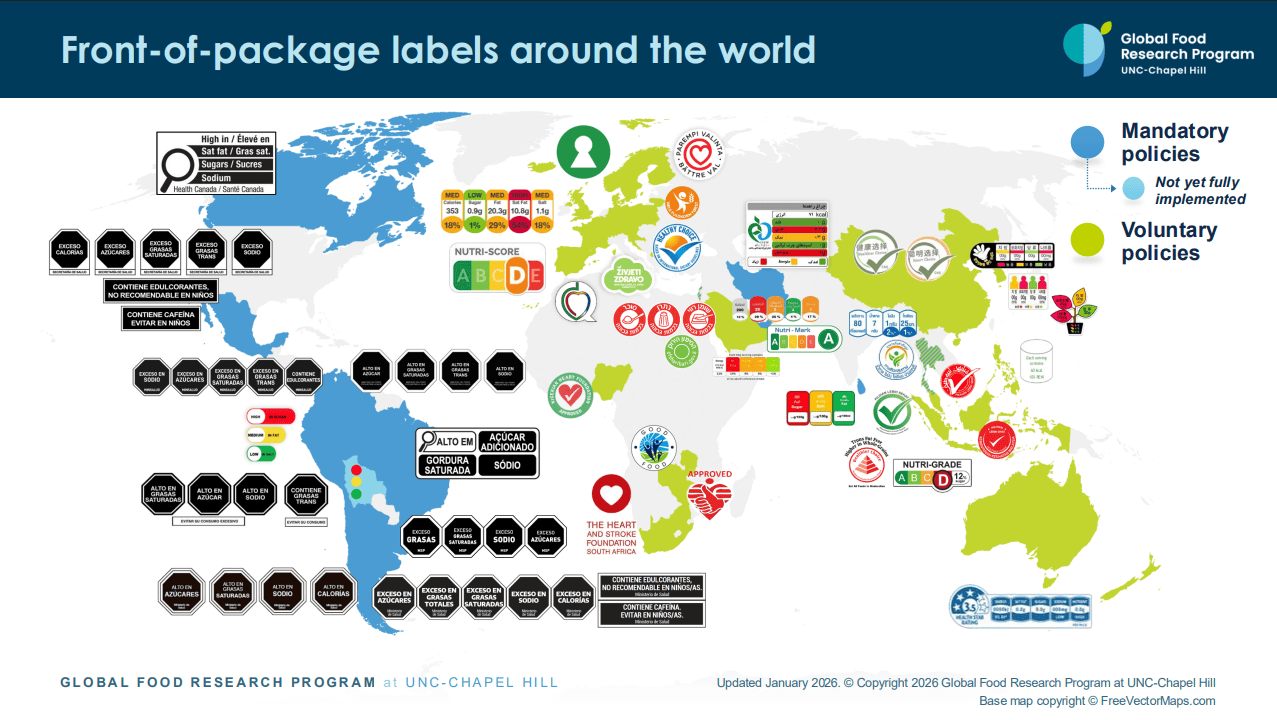
© Copyright 2026 Global Food Research Program at UNC-Chapel Hill. Base map copyright © FreeVectorMaps.com
Front-of-pack warning labels in countries such as Chile and Mexico focus on nutrients of concern and, in some cases, sweeteners. Restrictions in the UK on products high in fat, salt, and/or sugar (HFSS) rely on a nutrient profiling model.
Similarly, the Nutri-Score in certain European countries evaluates products through nutrient composition for labelling. China requires sugar and saturated fat labelling and health warnings for children for mandatory implementation in 2027.
Although these systems do not classify foods according to their level of processing, food processing and ingredient-level definitions are now being considered in discussions around dietary guidance, marketing restrictions, taxation and/or front-of-pack labelling.
As these policy approaches use different underlying criteria, this raises an important question: what additional value does classifying foods by their level of processing provide beyond existing nutrient-based systems?
The Rise of Ingredient-level Classification
The proposed MUPs approach attempts to create a more scalable and standardised way of identifying “UPFs” using ingredient list data. In theory, this allows classification to be applied consistently across large manufacturer and retailer datasets, but it also raises unresolved questions within the food processing debate.
One question is whether regulation is ultimately targeting specific ingredients or foods as a broader category. Discussions often move interchangeably between emulsifiers, stabilisers, sweeteners, flavourings, industrial formulations and processed foods themselves, despite these not necessarily representing equivalent policy targets.
Another challenge relates to evidence translation based on the available science to date. As a result, it leaves a gap between the descriptive categories used in dietary surveys and ingredient-level systems proposed for regulatory implementation.
The growing shift toward ingredient-level operationalisation therefore changes the nature of the debate. At the same time, implementation remains inherently difficult.
Currently, there is no globally harmonised MUP framework, raising practical questions around who determines the official list of markers, how lists are updated and how disagreements are resolved as (re)formulation practices evolve.
Emerging Attempts to Bridge the Implementation Gap
In May 2026, Healthy Eating Research (HER) convened an expert panel to evaluate existing UPF definitions and approaches for guiding policy development4. The report acknowledged that processing alone is not sufficient to determine the overall healthfulness of foods and instead is as an additional lens that may complement existing dietary assessment approaches.
In addition, inclusion of specific markers is not necessarily because those ingredients are individually harmful, but because they are viewed as indicators of foods categorised as “ultra-processed”.
However, while broader dietary patterns classified as “UPFs” may have been associated with adverse health outcomes in observational studies, it remains unclear whether the proposed ingredient-level markers used for policy capture those same associations.
The HER panel brought practical implementation challenges into sharper focus. These included maintaining and updating ingredient databases within rapidly evolving food supply chains, ensuring sufficient transparency around formulation practices, and managing the reality that static marker lists may quickly become outdated.
At the same time, the project reflects expansion of the field by applying proposed metrics to more than 90,000 products, highlighting how food classification systems need to consider real-world data to understand policy implications.
Reformulation and Shifting Incentive Structures
One of the most important implications of ingredient-level approaches relates to reformulation incentives. The Lancet series critiques nutrient reformulation by arguing that reductions in fat, salt and/or sugar may increase the use of additives or industrial ingredients.
Yet ingredient-level operationalisation could itself create a different set of reformulation incentives, which may take the form of optimisation away from “less sugar” towards “less emulsifier”, expanding previous trends on “clean(er) label” or “natural” ingredient substitution strategies.
If ingredient-level criteria become the primary regulatory gatekeeper, reformulation may lead to prioritisation of additive substitution and formulation optics over measurable nutritional improvements.
This creates a broader policy question: what exactly is regulation trying to incentivise – nutritional composition, degree of processing, category restrictions, ingredient familiarity, formulation simplicity, eating behaviour, or some combination of these factors?
California as an Emerging Real-World Test Case
A number of these tensions are now beginning to materialise in regulatory approaches.
California has become one of the clearest examples of attempts to operationalise the level of food processing within legislation. In 2025, the state introduced a formal “UPFs” definition for school food restrictions through AB 1264. More recently, AB 2244 proposed applying this classification through a certification scheme for non-“UPFs” and preferential retail placement for certified products.
Rather than relying solely on Nova categorisation, California’s approach combines ingredient-level markers with nutrient thresholds. Products may be classified as “UPFs” if they contain one or more listed additives while also exceeding thresholds for saturated fat, added sugar or sodium. However, products containing non-nutritive sweeteners or polyols may still fall within the definition even where nutrient thresholds are not exceeded.
The result is a system where HFSS does not always equal “UPFs”, and vice versa, which creates potential divergence. Nutritionally poor products may avoid “UPF” classification through “natural” substitutions, while products that have improved nutritionally may remain within restricted categories because of ingredient composition.
Alongside policy-led approaches, a growing number of third-party certification schemes have also been developed, particularly in the US, to certify foods as non-“UPF”. These schemes often apply different criteria and thresholds, further illustrating the fragmentation currently emerging within operational definitions.
Product-Level Data is Becoming Central
One of the clearest changes emerging is that the debate is moving beyond a single classification and increasingly overlapping with wider discussions on data infrastructure.
Policy impact ultimately depends not on whether a classification system appears coherent theoretically, but on what happens when it is applied across real-world products, retail environments, purchasing and consumption datasets.
A framework may appear conceptually robust yet generate unexpected divergence, inconsistencies or implementation challenges once operationalised at scale.
Questions around ingredient transparency, data access, and successful implementation are therefore becoming central to the future of food and nutrition policy.
Final Reflections
A key challenge for “UPFs” moving forward is considering where the concept genuinely adds value beyond existing policy approaches. Most stakeholders working in this space ultimately share similar goals: supporting healthier and more sustainable diets.
However, before “UPF” becomes embedded within regulatory frameworks, there needs to be greater clarity around what the concept is intended to achieve and whether current operational approaches remain coherent when applied consistently across real-world food systems and datasets.
Whatever direction the conversation takes, the future of “UPFs” feels likely to become more data-led, not only “definition-led”. As such, the next chapter may depend less on continuing debates around classification itself, and more on understanding what happens when these approaches are applied in practice.
Without this, there is a risk that unintended consequences and potential divergence beyond existing nutrient-based approaches remain poorly understood, particularly as regulatory development in this area continues to accelerate.
The KHNI Health and Nutrition Megatrends, now in its eighth edition, highlights the scientific, technological, and consumer-driven changes redefining global food systems.
Processing of fruits or vegetables can improve sustainability factors like shelf-life (e.g. freezing or juicing) or reduced shipping weight (dry powders), but many nutrients are sensitive to heat and oxidation that these processes can introduce.
Key dietary shifts are emerging through a collaboration of food science and nutrition with the aim to couple reductions in both our carbon footprint and risk of chronic disease, helping to build a sustainable healthy future for us all.
In 2019, Our World in Data, reported that 74% of global mortality was attributed to chronic disease, with CVD (cardiovascular disease), cancer and diabetes, being the main contributors.
Our eating habits and the associated increase in obesity worldwide being a primary cause of these statistics.
At the same time, Board Bia share statistics on food waste indicate over one third of all food produced in a year is wasted, contributing to almost 10% of global GHG (greenhouse gas) emissions and losses of €1.2 trillion each year.
This highlights the potential for food science and nutrition in preserving our future and there are some exciting dietary innovations already out there.
Nutritional Quality of Berry Fruit
A shift from western dietary patterns consisting of red meats and processed foods high in saturated fat, sugar and salt to the flexitarian style diet consisting of whole foods like fruits, vegetables, grains, pulses and oily fish is becoming increasingly popular.
These are more nutrient-dense high fibre options, but many of these foods contain non-nutrient compounds that have potential health benefits called phytochemicals.
Regardless of fresh or frozen, in the case of berries, they possess a nutritional edge due to their phytochemical composition which has been quantified in numerous studies (Toledo-Martin et al. 2018; Ponder et al. 2021).
Phytochemicals such as polyphenols, anthocyanins, stilbenes and carotenoids along with essential vitamins and minerals are found in common house-hold berries such as blueberries, blackberries, strawberries and raspberries.
Lesser common berries such as Sea Buckthorn and Mulberry are composed of the same phytochemicals. These compounds have been shown to have anti-inflammatory and antioxidant properties.
Berries as Antioxidants
The high antioxidant activity of berries due to their phytochemical concentration means they help to effectively scavenge unwanted oxidizing radicals from our body.
These oxidizing radicals are thought to be linked to development of different diseases and health conditions and may be one way berries work to improve health (Soobrattee et al., 2005).
Heart Health
Studies have shown phenolics such as ellagic acid present in these berries may protect against atherosclerotic plaque formation in our blood vessels, reducing the risk of hypertension and heart disease (Olas et al. 2008)
In 2015, the PREDIMED study concluded increased polyphenol intakes were associated with reduced blood pressure in trial participants as well as decreased biological markers of inflammation and oxidation, possibly contributing to reduced risk of cardiovascular disease.
Blood Sugar Management
Clinical trials in humans have shown the anthocyanins and stilbenes found in these berries may reduce the impact of postprandial hyperglycaemia (sugar spikes after a meal), which could protect cells of the pancreas and liver from oxidative stress and inflammation, leading to a potential reduction in the risk of type 2 diabetes (Blaak et al, 2012).
Processing and Berry Nutrition Quality
For many people, fresh berries are the preference when it comes to taste and texture, but these non-climacteric fruits have poor shelf-life.
Within a couple of days to a week, berries enter senescence and mould begins to grow. For this reason, freshly purchased berries are often thrown in the bin and this is a primary example of the food waste that contributes to significant GHG emissions.
Food scientists have looked at several berry preservation methods to prolong their naturally short shelf-life, but there is often a caveat associated with the properties of processed food.
Dried Berries
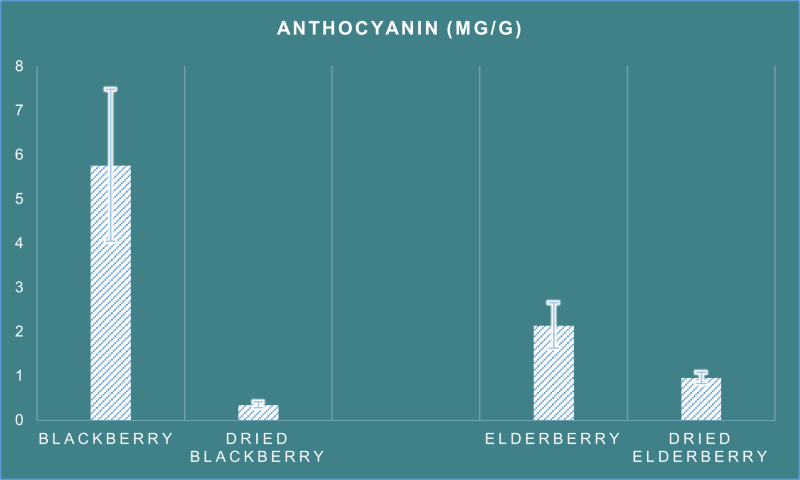
Thermal processing (dried berries), which aims to reduce the moisture content of the berries, will successfully extend shelf-life but causes leaching of certain nutrients and phytochemicals (Figure 1) which negatively impacts the nutritional value of the berries.
Juiced Berries
Juicing berries has also been a successful processing method in extending shelf-life, but this too causes a reduction in desirable phytochemicals such as anthocyanins.
These conventional processing methods are effective, but we need to think outside the box to make our food systems more sustainable. Shelf-life and nutritional integrity must be optimised. <
Frozen Berries
Freezing or freeze drying provides fruit and vegetable products with a variety of economic and environmental benefits.

Studies have shown berries maintain a complete nutritional profile after freezing (Lohachoompol et al., 2004) unlike other thermal processing methods.
This means shelf-life is improved without compromising nutritional profile which we now know is of great value in berries.
Economic and Environmental Benefits
There is no need to bin frozen berries a few days after they’re bought, immediately ruling out food waste.
As well as this, frozen fruit can be and usually are sold in larger volumes of up to 1kg due to improved stability post freeze-drying, compared to fresh berries which are usually sold in trays of 100g to 300g.
If we were to switch to frozen berries, this would significantly reduce the amount of plastic packaging required which is another crucial aspect of sustainability.
The fresh berries we buy often contain stems and leaves, otherwise known as ‘cut-offs’. These cut-offs are usually thrown to waste in the home.
However, innovative industries are now using cut-offs from fruit & vegetables going through the freeze-drying process to generate biogas through anaerobic microbial digestion, providing energy in a circular manner which is further reducing the waste generated from frozen fruit and vegetable production (Carlos Morales-Polo et al., 2019).
For consumers, there is also economic value to frozen berries. At one popular international grocery store, fresh berries cost between €10 and €20 per kg compared to frozen berries at approximately €3 per kg, indicating a significant cost-saving associated with frozen berries.
Freeze drying can strike a balance between sustainability and nutrition, making it a promising tool to consider for the future food system.