On July 29th, 2025, the KHNI hosted an expert scientific webinar; “Biotech at the table: Enzyme technology in modern nutrition”.
The expert panel broadcast from Kerry’s Biotechnology and Innovation centres in Leipzig Germany and Naas, Ireland, shaped the evolution of enzyme engineering and the advancements of machine learning and artificial intelligence in this field.
Enzymes play a leading role in sustainable nutrition
Dr. Niall Higgins began the webinar with insights into how biotechnology is radically transforming food processing, food production and food innovation through biotech solutions such as enzymes.
Enzymes have become an increasingly important ally due to their high efficiency, specificity and their ability to create a more efficient food system. As nature’s biocatalysts, Dr. Higgins emphasized that enzymes are a multifaceted technology enabling operational efficiencies, improving product quality, extending shelf life, valorising waste streams, unlocking nutrients and more.
Dr. Higgins used case studies to demonstrate that enzymes will continue to play a leading role by providing better nutrition and improved cost-effective processes that are ultimately having less impact on the planet’s resources.
Enzymes from discovery to disruption
Enzyme engineering is a highly dynamic and rapidly advancing field. Dr. Andreas Vogel explored the evolution of enzymes through time from discovery to disruption.
He highlighted where enzymes were first isolated from natural sources, followed by directed enzyme evolution which facilitates the tailoring of enzyme properties for specific industrial applications.
However, directed enzyme evolution also has its challenges. Dr. Vogel highlighted that smart strategies are needed to navigate these complexities, and provided a case study where enzyme engineering not only improves food production but also transforms consumer taste experiences.
Artificial intelligence to develop next generation of enzymes
Next Dr. Sebastien Bartsch brought our attention to a Nobel Prize winning breakthrough in 2022 with AlphaFold 2 which predicts enzyme structures with high precision and, since then, available enzyme structures grew significantly compared with the previous 60 years.
Dr. Bartsch brought us through what lies ahead with “next gen” enzymes. He considered why AI does not simply design the best possible enzymes for any given applications as, they are dynamic, constantly moving, and often have different conformational states.
Therefore, despite AI technology developing at an extremely fast pace, Dr. Bartsch pointed out that designing an active enzyme with a set of different features under industrially relevant conditions remains a challenge.
Consequently, there is an exciting future ahead for enzymes where continuous rapid improvements in bioinformatics, de novo protein design, AI, and tools like AlphaFold, will make significant strides in predicting protein structures and designing enzymes more efficiently.
Dr. Higgins closed out the webinar recapping on today’s session where:
• importance of continuous advances in biotechnology was emphasized.
• understanding of the current role of enzymes in the food and beverage industry was deepened.
• the impact of new-to-world enzyme solutions will influence and redefine the future of the food and beverage industry, by leveraging the rapid and recent biotechnological advances.
Finally, ending the webinar was a lively Q&A session where viewers asked questions and the team provided their insights.
For more information on this topic and many others visit The Kerry Health and Nutrition Institute. You are welcome to Subscribe to our monthly newsletter to stay up to date with these insights and more.
The future of food production relies on significant advances in microbiology, bioprocessing, enzyme technology and artificial intelligence, to feed a growing population while also reducing the negative impacts of food production on the planet.
Recent advances in synthetic biotechnological processes such as precision fermentation and enzyme & strain engineering are proving pivotal in the development of future sustainable nutrition.
And they are directly influencing many of the global challenges such as improving the efficiency of agricultural processes, reducing food waste and addressing consumer demands for healthier, more sustainable products without any compromise on taste.
Enzymes – Nature’s Biocatalysts Enable Sustainable Nutrition
On this sustainability journey, enzymes have become an increasing important ally due to their high efficiency, specificity and their ability to create a more efficient food system.
Used in food production for centuries and produced commercially since the mid-20th century, enzymes, as nature’s biocatalysts, are a multifaceted biotechnology for the food and beverage industry, enabling operational efficiencies, improving product quality, extending shelf life, valorizing waste streams, unlocking nutrients and more.
To maximise their impact, enzymes must be highly efficient & economically competitive in their industrial settings, this requires finely tuned biocatalysts that are not only robust and stable but highly selective under industrial process conditions.
And here lies the exciting part, scientists have only just reached the tip of the iceberg in understanding and exploiting the potential of enzymes.
Remarkably, only a tiny fraction of all potentially available enzymes from natural resources have been discovered and utilised to date.
When you couple this incredible potential with increased consumer focus on health, environment, sustainability and the ongoing research and innovation focus on enzymes optimisation, it is clear that the future of enzymes is to positively disrupt our food system by building a more efficient and sustainable food chain.

Image from: Industrial Enzyme Applications (2019)
To date, food and beverage manufacturers have utilised to great effect the power of well-known enzymes in application, but to truly transform food production, novel functionalities are required.
As a result, there is a new wave of directed evolutionary enzyme technology to deliver improved functionalities to new or existing enzymes, which enable food producers to create healthier, tastier products that have less impact on the environment.
For example, the food and beverage industry is now on an on-going quest for safer and cleaner methods to produce various compounds such as sweeteners, emulsifiers, pre- and postbiotics and fermented ingredients.
Inspired by the work of individuals such as Frances Arnold (2018 Nobel Prize Winner in Chemistry), this has triggered a focus on harnessing enzymes and enzymatic cascades that will complement or even replace bulk chemical ingredient and high energy processes with more natural and sustainable options.
Optimizing Enzymes through Bio-Engineering
Enzyme engineering allows the optimisation of enzyme properties through introduction of changes into the amino acid sequence of the protein.
These properties include enzyme activity, selectivity, stability as well as the appropriate substrate scope and concentration.
This begins with the use of enzyme variant libraries which are analysed in a high-throughput format for the desired properties.
Bioinformatics is used to design genes, analyze structural and sequence information and finally store the data sequence and function in a database. The latter allows us to learn from the gathered data using Artificial Intelligence and Machine Learning.

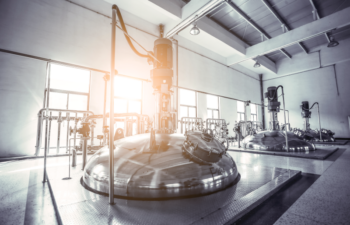
Using this variant information coupled with molecular biological methods in hand, it is possible to train microbial strains, which grow to high cell densities in large fermentation vessels to produce an enzyme from a different origin to high titers.
Several host organisms from bacterial, yeast and fungal kingdom have developed enzyme production strains. They differ in their capability for the functional production of a foreign enzyme, which depends on the source and nature of the enzyme.
As there is no universal production strain, an enzyme producer needs a portfolio of different strains and the expertise to cultivate them to high densities and to maximise enzyme production.
Challenges to Accept GM Technologies
However, there are many challenges regarding the implementation and acceptance of such technological developments.
One such challenge will be the opinion of the consumer, who ultimately needs to be convinced that future food will be in some part produced by engineered microorganisms.
Interestingly the utilization of engineered non-wild-type microorganisms may sound futuristic but there are already many examples of commercial products from engineered microbes. For example, in food production, engineered microbes can be used to produce specific enzymes to help degrade acrylamide in coffee extracts or to more efficiently produce natural high-intensity sweeteners from plants.
These examples illustrate the potential for balancing traditional food fermentation practices and modern biotechnologies.
As new enzymes are brought into the food chain, the requirements to meeting food safety regulations is of key and growing concern.
Additionally, the rapid and continuous improvement of genomic technologies which are used to characterise and classify production strains (future and current) will significantly impact the regulatory landscape regarding their use in food, feed and beverage applications.

The dynamic landscape of sustainable nutrition is being reshaped by the remarkable strides in enzyme and strain engineering, as well as precision fermentation technologies.
The potential for these advancements to revolutionise food and beverage production is substantial, with the promise of enhanced efficiency in agricultural processes, reduced food waste, and the creation of healthier, more sustainable products that cater to evolving consumer preferences.
As we navigate the challenges associated with the acceptance of genetically modified technologies and ensure compliance with stringent food safety regulations, the ongoing collaboration between scientists, bioengineers, and regulatory bodies will be pivotal.
The fusion of enzyme engineering with cutting-edge bioinfomatic approaches opens new frontiers for the creation of novel enzymes, paving the way for a future where sustainable nutrition is not just a goal but a reality.