The list of fad weight diets is almost endless, and a the 2021 Food and Health Survey from the International Food Information Council showed intermittent fasting in the top 3 diets followed by consumers for the 3rd year in a row.
Most diets have one thing in common, though: they all over-promise easy and quick weight loss.
Short-term these diets may lead to weight loss, but over the long-term we know most people will gain the weight back, if not more, because they haven’t learned how to develop healthy eating habits for life.
Does intermittent fasting work? Unlike many of these weight loss fad diets, intermittent fasting has been slowly gaining traction in the research world.
What exactly is intermittent fasting and how does it help lead to weight loss? First, let’s define intermittent fasting as there are several different versions of the diet in the mainstream.
What is Intermittent Fasting?
Adapted from Patterson, 2015.
How Does Intermittent Fasting Work for Weight Loss?
Typically, when a person wants to lose weight, they will reduce the number of calories below their normal daily intake over time.
For example, a rule of thumb is to reduce daily calorie intake by 500 to lose one pound in a week, since one pound is equal to ~4500 calories. This is called continuous caloric restriction (CCR) and is the ‘traditional’ weight loss diet.
Studies have shown that CCR regimes not only reduce body weight they may also help prevent obesity-related diseases [NIA 2018, Schübel 2018]. It is important to note that CCR does not cause malnutrition or deprivation of essential nutrients [NIA 2018].
A fasting diet or intermittent caloric restriction (ICR) is an eating regimen where a person does not eat at all or severely limits intake during a certain time frame (e.g, day, week, month) [NIA 2018]. Over time on a fasting diet, a person may consume fewer calories thereby leading to weight loss.
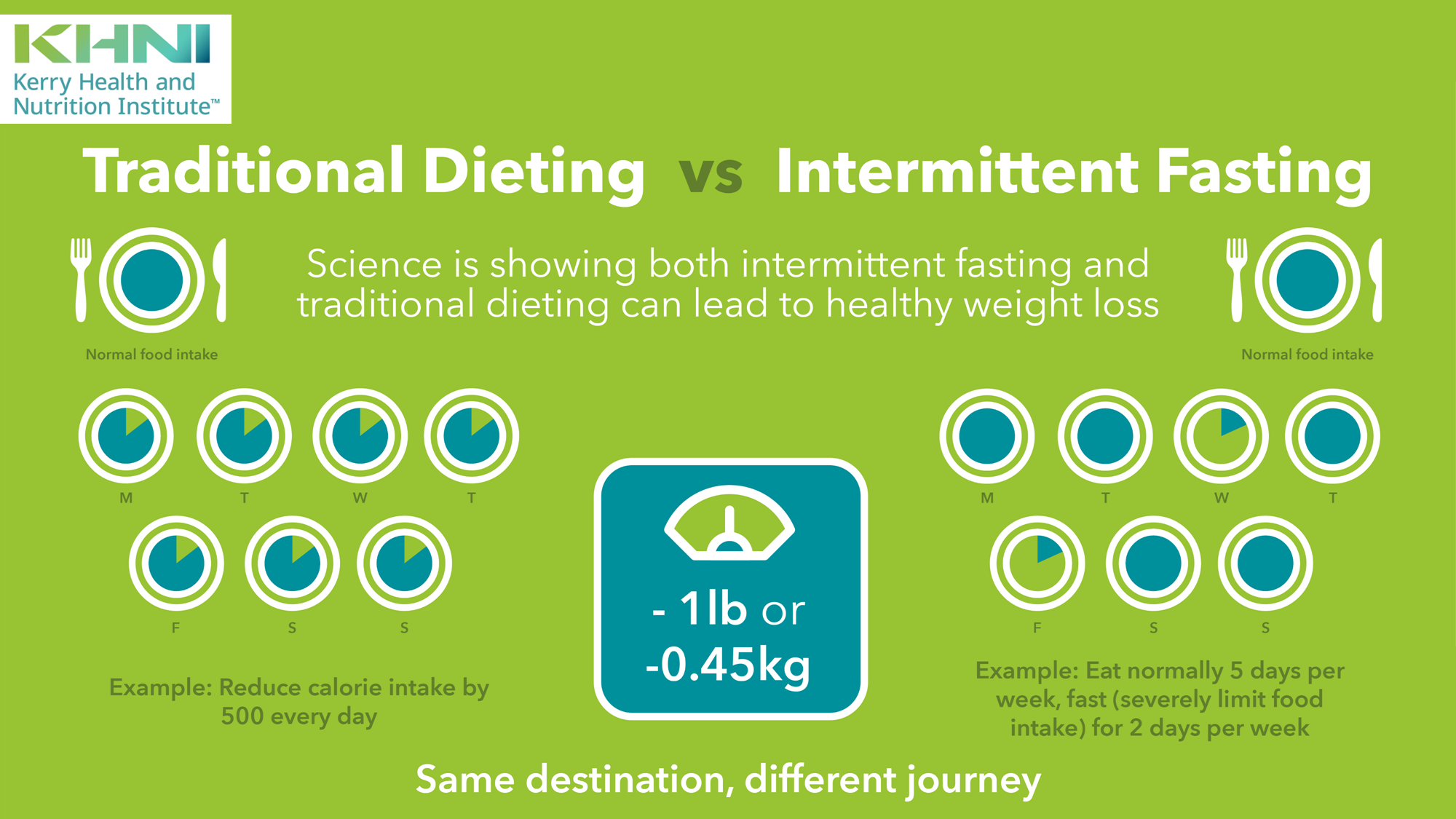
Decreased calorie intake, whether it’s done through CCR or ICR, leads to weight loss.
This might seem like a no-brainer, but research is starting to show that not only do fasting regimes lead to weight loss, but they may have greater metabolic benefits including lower insulin levels and decreased fat mass compared to traditional dieting [Harvie 2011, 2013].
Intermittent Fasting Benefits
A recent systematic review of four intermittent fasting studies reported a decrease in fat mass and reductions in both low-density lipoprotein (LDL) and triglyceride levels, suggesting improvements in cardiovascular health [Ganesan 2018].
Additional studies are also suggesting that these fasting regimens help lead to weight loss with potential effects on glucose metabolism and inflammation.
These are also benefits shown by traditional weight loss diets, suggesting intermittent fasting may have similar benefits. As more studies on intermittent fasting are conducted, systematic reviews continue to support these cardiometabolic benefits.
Like other intermittent fasting regimens, time restricted eating is also associated with weight loss and may be important for optimal metabolic function [Patterson 2015].
Why researchers are observing these metabolic benefits with ICR is still unknown. More research will help to identify the mechanisms behind the benefits.
Fasting is a major component of Ramadan, and a review of studies focusing on the effects of fasting during Ramadan reported weight loss and lower levels of low-density lipoprotein cholesterol and fasting blood glucose in both men and women when compared to the beginning of Ramadan [Kul 2013].
Other studies have also reported that Ramadan fasts are associated with lower levels of inflammatory molecules in the blood stream (e.g. C-reactive protein, interleukin-6, tumor necrosis factor-alpha; Aksungar 2007, Faris 2012).
However, these types of molecules are produced normally by our bodies as part of metabolizing the food we eat, so it may make sense that restricting food would lead to lower measurements.
The more important question, and what is still unknown, is whether these changes are permanent or if they go away when people resume their normal eating habits.
Which One is Better, Continuous Calorie Restriction (CCR) or Intermittent Fasting?
To date, most systematic reviews of intermittent fasting studies have suggested that intermittent fasting is equal to standard CCR regimens when it comes to weight loss [Patterson 2015].
More recently in 2018, Shubel et al. showed that the 5:2 diet is equivalent, but not superior, to traditional CCR diets for weight loss and the prevention of metabolic diseases.
A systematic review from 2021 comparing intermittent fasting diets versus CCR diets found that intermittent fasting diets were associated with higher weight loss in four out of 18 studies. At this point, it appears that both dietary methods of weight loss have similar effects.

How Does Fasting Help Improve Health?
While health improvements from fasting might sound counter-intuitive, science is starting to show there might be something to it. The exact mechanisms of action are still unknown, but to date a few hypotheses have been proposed to explain how intermittent fasting can benefit overall health [Patterson 2015].
Recent studies have suggested there is a possible link between the microbiome and these cardiometabolic intermittent fasting benefits.
These hypotheses include:
- Improvement in the gene expression associated with the circadian rhythm to favour energy metabolism and body weight regulation. In other words, fasting regimens may impose a daytime rhythm in food intake, leading to improved energy metabolism and body weight regulation.
- Enhancement of beneficial colonies of gastrointestinal microbiota which may be more favourable to weight loss.
- Modification of lifestyle behaviors (e.g. energy intake, energy expenditure, sleep) may accompany fasting behaviours.
To Fast or Not?
So, does intermittent fasting work? The short answer is yes, it is at least equally effective as traditional weight loss methods. Every year more studies are reporting benefits beyond weight loss with intermittent fasting regimens.
It is still too early to say that one fasting regimen is better than the other, but studies are showing at the very least these eating patterns lead to weight loss and could even improve overall health.
The questions that remains to be answered is whether or not these regimens are sustainable over a lifetime in adults as well as whether these regimens help reduce risk of diseases.
So, when considering trying an intermittent fast, an appropriately qualified health professional must be consulted to ensure an adequate macro- and micro-nutrients diet is achieved.
In the past decade, foods like coconut oil and bulletproof coffee have been in the headlines of countless nutrition news articles. One of the most common questions dietitians get asked is “what’s the truth about coconut oil, is it healthy?”.
Scientific studies have shown that consuming certain types of dietary fats can reduce the amount of food eaten later in the day. These dietary fats are known as medium chain triglycerides, or MCTs for short. Coconut oil’s surging popularity in the last decade is partly due to the media promoting coconut oil for weight loss, advocating similar health benefits to that of MCTs.

In this blog, it’s time to take a look at the science behind coconut oil and MCTs. It is based on a study that was carried out with the primary intention to compare the effect of MCT oil to coconut oil on food intake and feelings of hunger, fullness, desire to eat and prospective food intake in healthy subjects.
The basics on fat
Historically, high-fat diets have long been linked to overweight and obesity. However, new studies are suggesting that certain fats can have a positive influence on weight.
This is because, as we now know, not all fats are the same. There are ‘good’ fats and ‘bad’ fats. This is probably why going totally ‘low fat’ or ‘fat free’ didn’t seem to make us any healthier. When we cut out fat from our diet, we ended up missing out on what are known as good fats and essential fats.
For more information on the type of food or fat to choose, see our blog ‘Does Low-Fat Still Matter?’.
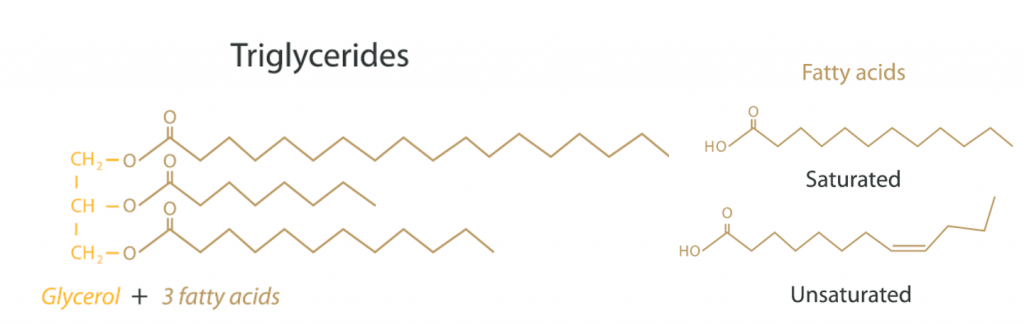
All fats are made up of the same components, but the various structures of different fats give them many different functions within our bodies once consumed.
|
Get KHNI articles delivered to your inbox
|
What are MCTs and how are they different from other fats?
Like we see in the image above, natural dietary fats are made up of fatty acids composed of chains of carbons. Fatty acid lengths can vary from 8 to 22 carbons long; most fatty acids have a carbon length of 14 or more. MCTs are triglycerides that are made up of mostly medium chain fatty acids, which typically have a length between 6 and 12 carbons (Bach and Babayan, 1982). This different structure is what gives MCTs their unique properties.
MCTs have a smaller molecular weight, are most commonly liquid at room temperature and have a lower melting point than other naturally occurring fats found in the food chain. This structure is also what allows MCTs to act in an alternative way to other fats when absorbed by the body, which is discussed below (Bach and Babayan, 1982).
MCTs are naturally found in the food chain in coconut oil, palm kernel oil and dairy fats. They became of interest in the food chain in the 1950’s when studies focused on how fats are absorbed in the body (Nagao and Yanagita, 2010).
Most MCT oil is extracted from tropical oil sources (palm or coconut), filtered and then concentrated (re-esterified). It is thought that this restructuring is key to the effect MCTs have on reducing food intake and weight gain.
How are MCTs absorbed and what does that mean for weight gain?
When we eat and digest most dietary fats, they are absorbed into our bodies in a different way than nutrients like protein or carbohydrates. This is due to fat’s inability to properly mix with water (think oil and vinegar), meaning most fats don’t go directly to the liver like proteins and carbohydrates do. Unlike other fats, however, MCTs do go directly to the liver when consumed due to their unique structure. This allows the body to quickly use these fats as energy, which can then be burnt off by the body through activity, reducing the amount of weight gained. MCTs also contain fewer calories per gram than typical fats (~8.3 calories per gram instead of 9 calories per gram). Other fats consumed are more likely to become fat deposits (adipose tissue) in the body when we eat too many calories due to their alternative absorption method making them less available to be used as energy (Babayan 1987).

This difference in the way our bodies utilize MCTs compared to other naturally occurring fats (Rolls et al, 1988) has been suggested as contributing to the effect of MCTs on contributing to fullness and reducing food intake.
If you want to know about the science of how MCTs are utilized by our bodies, this article is a great reference.
What is the difference between MCT oil and Coconut oil? Does coconut oil live up to the hype?

Most plant-based fats are unsaturated (liquid at room temperature), however coconut oil is a unique plant-based fat in that it is made up of 92% saturated fat. Although most of the fat in coconut oil would be considered to be MCTs, the fatty acid found in these MCTs are longer than most other MCTs. Due to this length, the absorption of coconut oil differs from that of MCT oil. Only a small percent (20%-30%) of coconut oil is absorbed through the liver and readily available to be burned off as energy by the body, where as 95% of MCT oil derived from other sources is absorbed this way (Denke and Grundly, 1992).
As a result, the evidence around whether coconut oil can be promoted as a way to help with weight or appetite regulation varies. The results of this recent study and previous studies (St-Onge and Bosarge, 2008), show that MCT oil has beneficial effects for reducing obesity through reducing food intake and increasing fullness compared to coconut oil (Mumme and Stonehouse 2015). The way MCTs achieve this effect is still being explored, but one possible explanation is the rapid rate we absorb them.
With fat gaining popularity with consumers, there may be many opportunities to add fat back into products. It’s important to make sure these fats are from a healthy source and the calorie content of foods is still not too high. Even too many healthy fats can contribute to weight gain. If you want to add fat to a product to improve satiety or help weight management, the best bet would be to use MCT oil rather than coconut oil.