The European legislation for Emulsifier E471 (mono- and diglycerides of fatty acids) will be amended by the European Commission after recommendations by the European Food Safety Authorisation (EFSA).
The updated specification for E471 will be extended with additional contaminants commonly found in emulsifiers, i.e., Glycidyl Esters (GE) and 3-monochloropropanediol (3-MCPD).
Mono- and diglycerides are used across a range of F&B applications, e.g., bread, dairy, margarine, dressings, chocolate, ice cream and confectionery, to name the main ones.

In EFSA’s initial request for information, they called for more data regarding potential contaminants in E471 (such as trans fatty acids, heavy metals, erucic acid, butanetriols and acrolein).
Food emulsifier producers specify these analytical results and the lowest technically achievable levels of 3-MCPD and Glycidyl Esters in E471. Up until now, these were not included in the specification for E 471.
After the EFSA’s call for data for E471, European emulsifier producers worked together to define maximum technical achievable levels of those contaminants and submitted their findings to EFSA in December 2020.
The European Commission included only the contaminants heavy metals, 3-MCPD and GE in the revised specification (the other earlier mentioned contaminants were not included). The revised specification received a favourable opinion from the EU member states on the March 8, 2023.
As such, the proposed specification is expected to be adopted and the legislation to be enforced by mid-summer of this year. T he draft specification includes a six-month transition period for both E471 itself and food containing E471.
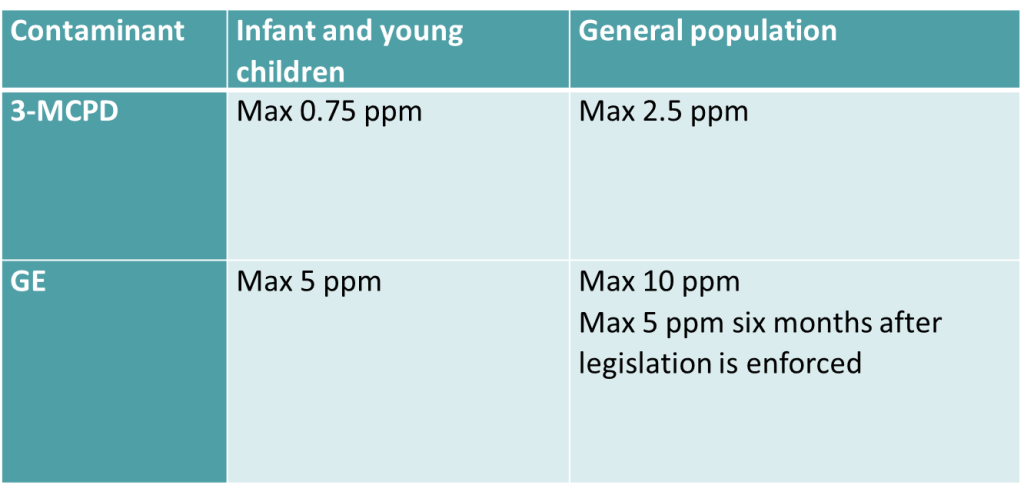
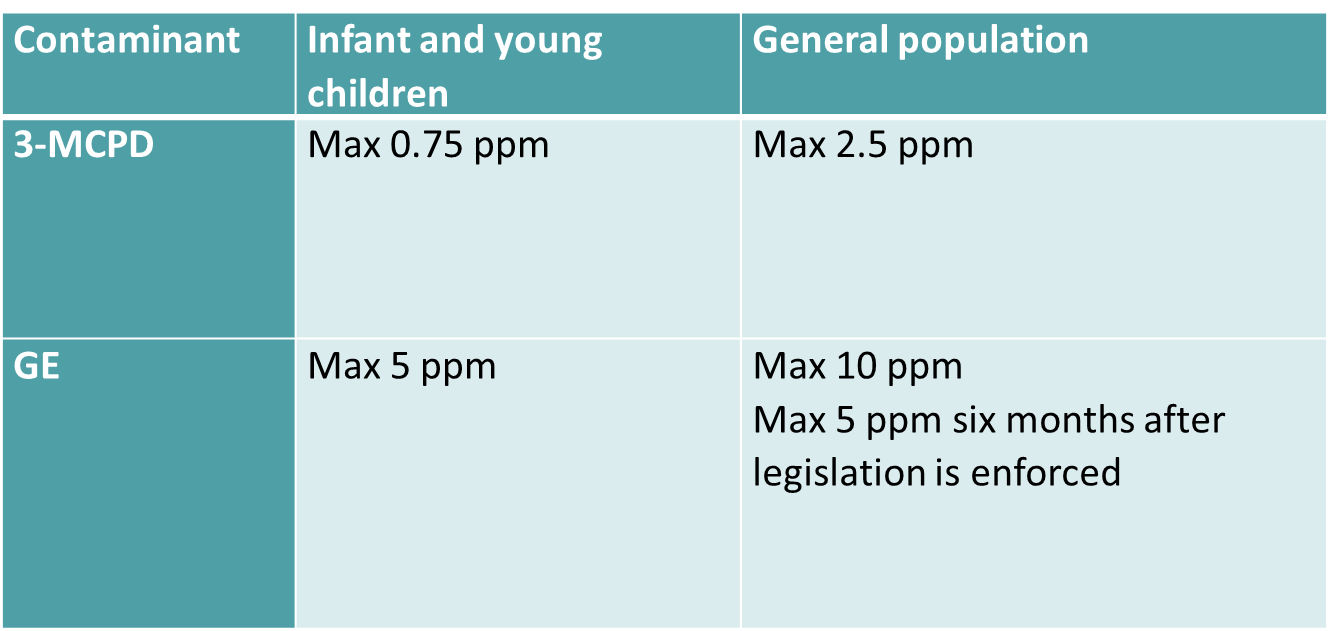
The upcoming legislation for the additional contaminants is specified as per below:
What You Need to Know as a Food and Beverage Manufacturer
The E471 emulsifier industry is responsible for meeting this new legislation and deliver compliant E471 into the market. It may be expected as responsible producers to ensure customers/F&B manufacturers are kept informed of current proceedings.
In addition, according to the new legislation, E471-containing food products produced outside Europe but exported into Europe must adhere to the updated E471 standard.

Background
The use of food additives (E-numbers) within the EU is governed by strict rules and regulations. Each E-number has undergone a stringent safety evaluation by the European Food Safety Authority (EFSA), and when found safe for use has been authorised by the European Commission.
EFSA periodically revises specifications of E-numbers, at which point they are re-evaluated in risk assessments.
In November 2018, EFSA launched a public call for technical and toxicological data on food additive E471 (mono- and diglycerides of fatty acids).
EFSA recommended adapting the current specifications for mono- and diglycerides of fatty acids (E471), in particular by reducing the maximum allowable limits for toxic elements of safety concern and including two new contaminants.
All European food emulsifier producers are members of the non-profit industry organisation EFEMA (European Food Emulsifier Manufacturers Association), and worked together as responsible producers to prepare the required documentation to address this request from EFSA.

Click on each link o navigate to that part of the page.
-
- Why are 3-MCPD and glycidol esters (GE) considered contaminants?
- What are 3-MCPD and GE and how are they formed?
- What is the source of 3-MCPD and GE in food emulsifiers, E 471?
- Have E 471 manufacturers developed effective mitigation techniques?
- Analytical method for 3-MCPD and GE
- What are the new levels proposed as part of this legislation and when will it come into effect?
Why are 3-MCPD and Glycidyl Esters (GE) Considered Contaminants?
3-MCPD is a Group 2B IARC “possible” human carcinogen and thus may cause cancer, and could also pose risks to kidney function and the male reproductive system [1][2].
Glycidyl esters are classified as genotoxic and are a Group 2A “probable” human carcinogen [3][4].
What are 3-MCPD and GE and how are they formed?
3-MCPD esters and GE are predominantly formed during the refining process of vegetable oils in the deodorisation step that involves very high temperatures up to 230oC.
The formation of these contaminates is also related to food with high fat content that have undergone thermal processing (e.g., frying and baking) [5][6][7].
What is the source of 3-MCPD and GE in food emulsifiers, E 471?
Several studies have shown that mono- and diglycerides (E 471) are precursors for the formation of GE in oils and fats [5][6][7] and thus GE is an unavoidable by-product in the production process of E 471.
The formation of GE is increased with concentration of mono- and diglycerides, and with temperatures above 220°C [8]. Apart from mono- and diglyceride concentration and high temperatures, the formation of GE is also influenced by other parameters, such as the oil source and the fatty acid composition.
For example, mono- and diglyceride from unsaturated oils and fats can have higher levels of GE than fully hydrogenated fat-based products. In addition, processing conditions (i.e., processing time, catalysts, steam, vacuum and mixing) can influence the final concentration.

3-MCPD is neither formed nor removed in the manufacturing process of E 71. Formation of 3-MCPD requires chlorine, which is not present in the manufacturing process for E471.
As such, the 3-MCPD level in E 471 is introduced only via the raw materials sourced and used in the manufacturing process of E 471.
Have E 471 manufacturers developed effective mitigation techniques?
Over the last several years, EFEMA members have carried out extensive research and development work to thoroughly understand the chemical pathways and conditions affecting the formation and degradation of GE.
GE is formed at high temperatures, but, at the same time, GE is also an unstable epoxide at high temperatures. Mitigation involves a controlled heat treatment of the reaction mixture after formation of mono-and diglycerides and the associated, unwanted GE by-product.
The mitigation technique requires the installation of specialised equipment.
A significant part of the mitigation process has already been completed by European producers, and a large proportion of E471 efforts are focused on meeting the upcoming legislation of maximally allowed 10 ppm.
Mitigation implementation and further process optimisation are ongoing to be able to enable the tighter specification of max 5 ppm GE to be in place six months after the legislation comes into force.
Analytical method for 3-MCPD and glycidyl esters
No accurate analytical method existed for E 471 when the initial EFSA call for data on GE and 3-MCPD was requested in 2018. The available and published methods—the AOCS 29a-c methods—did not give reliable results for food emulsifiers.
EFEMA has worked for over two years with the SGS Germany laboratory on the development of an appropriate and reliable method for the measurement of 3-MCPD, 3-MCPD esters and GE in emulsifiers.
A method based on a modification of the AOCS Official Method Cd 29b-13 with gas chromatography–mass spectrometry (GC/MS) has been developed for E471.

The method has been validated by an internal ring test among EFEMA members and was released in summer 2020 by EFEMA. Dr. Jan Kuhlmann of SGS published the method in October 2021 [9].
The analytical method is highly laborious, requires specific equipment and demands a significant investment. In addition, the method is not yet validated by the EU reference laboratory and is still in the process of achieving proper validation.
EFEMA is aware that the National Food Institute at Technical University of Denmark (DTU Food), which hosts the European Union Reference Laboratory (EURL) for processing contaminants, has worked on a validation study of the method.
What are the new levels proposed as part of this legislation and when will it come into effect?
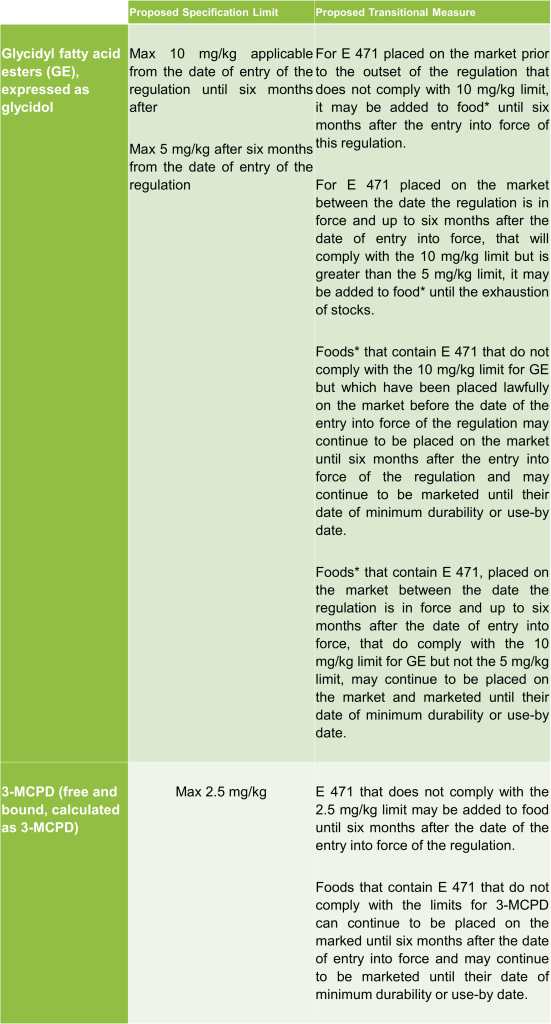
To ensure a minimal impact on end customers, the European Commission has proposed transitional measures for dealing with products containing E 471, and for E 471 itself.
These transition periods permit producers to use E471 with GE above 10 ppm if the E471 was produced prior to the regulation coming into force. The food that contains the E471 with GE above 10 ppm may be marketed until the use-by date.
Additionally, E471 with GE above 5 ppm and below 10 ppm that has been manufactured after the regulation has come into force may be used by producers until the exhaustion of stocks. Similar to the 10 ppm transition rules listed above, food containing this E471 may be marketed until the use-by date.
The proposed specifications and transitional measures are as follows:
What is the Difference Between Sugar and Added Sugar?
For those in the food and nutrition world, added sugar might be something we hear about every day.
Global dietary recommendations continue to recommend reducing added sugar intake, legislation taxing added sugar content of foods or beverages is increasingly common, and the update to the nutrition facts label in the US requires listing added sugars as a separate line item.
This can leave many of us, especially product developers trying to reduce added sugar content of foods or beverages, left wondering “how do I tell if sugar is added or naturally occurring?”
Here we take a look at regulatory guidelines from some major agencies around the world.
Global Guidance on Sugar Labelling
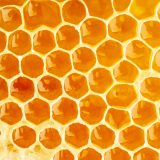 The WHO and FAO most often refer to the term ‘free sugar’ rather than ‘added sugar’.
The WHO definition of term free sugars refers to ‘monosaccharides (such as glucose, fructose) and disaccharides (such as sucrose or table sugar) added to foods and drinks by the manufacturer, cook or consumer, and sugars naturally present in honey, syrups, fruit juices and fruit juice concentrates’.
By this definition, for example, fruit juice would contain free sugars but might not be considered an ‘added sugar’ unless it was added to another food or beverage for the purpose of sweetening.
The EFSA and FDA go into further detail about definitions of what is and isn’t an added sugar.
Added Sugars in Europe (European Food Safety Authority)
Added sugars are considered empty calories (i.e. supplying energy but little else nutritionally) and therefore have been the focus of increasing attention in dietary guidelines in recent years.
This focus culminated recently in the UK with the introduction of a levy on soft drinks that contain added sugar in the hope of tackling rising obesity rates there.
So what exactly is “sugar” and in particular “added sugar”? As per Regulation (EU) No 1169/2011 on the provision of food information to consumers “sugars” are defined as “all monosaccharides and disaccharides present in food, but excludes polyols”.
To date, there is no similar clear-cut definition of the term ‘added sugars’ in the same piece of Regulation.
However, Regulation (EC) No 1924/2006 on nutrition and health claims made on foods does reference a “No Added Sugar” claim as “where the product does not contain any added mono- or disaccharides or any other food used for its sweetening properties.”
Within the food industry, this then prompts discussion on how to define “any other food used for its sweetening properties”. For example, can fruit juice used in a recipe be considered as added sugar?
Based on the current EU definition, if it is not added into the recipe for its sweetening property, it is not considered added sugar.
In 2010, European Food Safety Authority (EFSA) published its Scientific Opinion on Dietary Reference Values for carbohydrates and dietary fibre, which also included sugar and defined the term “added sugars” as “sucrose, fructose, glucose, starch hydrolysates (glucose syrup, high-fructose syrup) and other isolated sugar preparations used as such or added during food preparation and manufacturing.
Sugar alcohols (polyols) such as sorbitol, xylitol, mannitol, and lactitol, are usually not included in the term “sugars”.
While a certain level of ambiguity remains around the term “added sugars”, what we do know is:
- Added sugars are those sugars that are removed from their original source and added to foods, usually as a sweetener or as a preservative for longer shelf life. It is important to note that sugar presents itself in many guises on food labels(e.g. dextrose, lactose, molasses, invert sugar, fructose, glucose, maltose, saccharose, glucose-fructose syrup)
- Naturally occurring sugars are natural sugars present in fruits & vegetables (Fructose) and dairy products (Lactose).
- EFSA is planning to provide scientific advice on the daily intake of added sugar in food by early 2020. This, in turn, may further aid the definition of “added sugars” and how we should interpret it within the food industry.
Source: European Food Safety Authority: Scientific Opinion on Dietary Reference Values for carbohydrates and dietary fibre. EFSA Journal 2010; 8(3):1462 [77 pp.]. EFSA Journal 2010; 8(3):1462
Sugar Labelling – United States (Food and Drug Administration)
In the US, the FDA definition of added sugars includes sugars that are either added during the processing of foods, or are packaged as such, and include sugars (free, mono- and disaccharides), sugars from syrups and honey, and sugars from concentrated fruit or vegetable juices that are in excess of what would be expected from the same volume of 100 percent fruit or vegetable juice of the same type.
The definition excludes fruit or vegetable juice concentrated from 100 percent fruit juice that is sold to consumers (e.g. frozen 100 percent fruit juice concentrate) as well as some sugars found in fruit and vegetable juices, jellies, jams, preserves, and fruit spreads.
The sugars in fruits and vegetables (and their juice concentrates) have provided quite a bit of confusion with regard to labeling added sugars on the nutrition facts label.
Here is a breakdown of situations where the sugar from these sources may or may not be considered added sugar, according to the FDA (page 33835):
May appear as ‘added sugar’ on a nutrition label:
- Juice concentrates that are used to sweeten other foods are considered added sugars and thus need to be included in the new nutrition facts category
- If a fruit or vegetable has been processed so that it no longer contains all of the components of the whole fruit that is typically eaten—the pulp, for example—and the sugars have been concentrated, then those sugars need to be included in the added-sugar portion of the nutrition panel (such as adding raspberry puree to a snack bar)
- If sugars are in excess of what would be expected from an ingredient made from 100 percent fruits or vegetables, those sugars must be declared as added sugars
May not appear as ‘added sugar’ on a nutrition label:
- Fruit or vegetable juice concentrates used towards the total juice percentage in a juice (for products claiming to contain fruit or vegetable juice). For example, a blend of fruit and vegetable juice concentrates to create a 100% juice beverage.
- The fruit component of fruit spreads
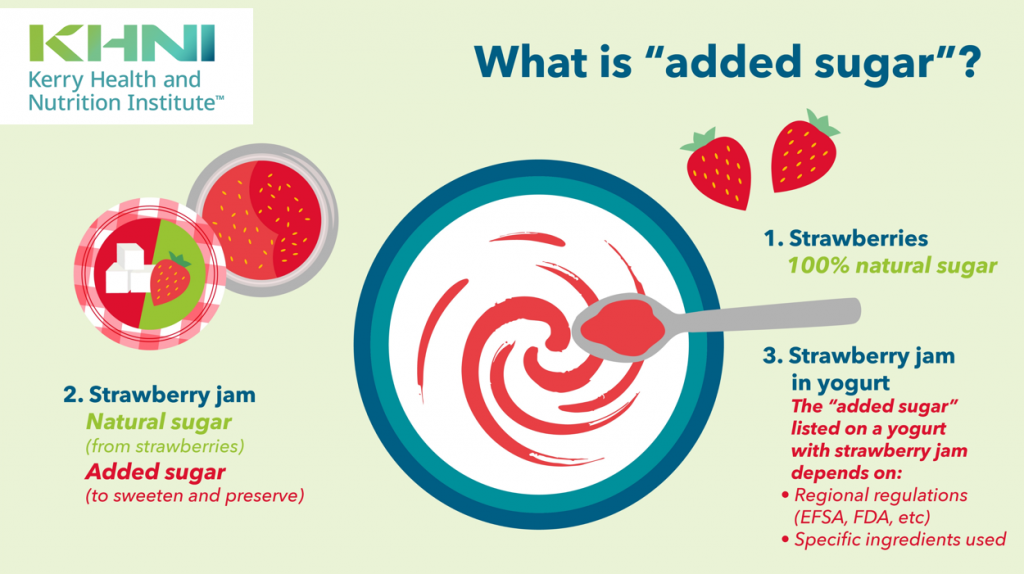
Some of these regulations can seem open for interpretation, such as when you add a fruit spread to a yogurt, so the FDA has published a helpful Question & Answer tool to help figure out what should or should not be considered added sugar for many different situations.
Given the slight differences in regulations between regions, as well as different ways the regulations can be interpreted, strategies for reducing added sugar in foods and beverages should always be developed on a case-by-case basis.
One key strategy moving forward is reduction in total sugar for foods and beverages.
Please bear in mind that the information above is only a present interpretation of regulatory documents and not intended to be used for formal guidance.