Vitamin C is one of the most common nutrients that comes to mind when thinking about immune health. It is a water-soluble vitamin that serves as a cellular antioxidant, which means it protects cells from reactive oxygen species and cellular damage 1. By protecting both the skin barriers and immune cells from damage, it enables them to function properly. It is required by cells from both the innate (general) and adaptive (specialised) immune system 2.
The innate immune system is the body’s first line of defence. When pathogens like infectious bacteria or viruses get into the respiratory tract or gastrointestinal system, the innate immune system responds by sending cells like neutrophils or macrophages to remove the threat. These cells try to engulf the invading pathogen or create enzymes to destroy it.
The adaptive immune system specifically targets the pathogen and takes over from the innate immune system. It is often described as the ‘memory’ of the immune system. Once exposed to a pathogen, the immune system can remember the identity of that pathogen for the future and quickly mount a defence specific to that pathogen.
Vitamin C promotes barrier function, supports the function of neutrophils, monocytes, and macrophages and the activity of NK cells. It also has a role in the differentiation and function of T cells, especially cytotoxic T cells and in antibody production 1. This role has been recognised in an approved European Union health claim for vitamin C, stating that it “contributes to the normal function of the immune system” and is available to foods subject to condition within the EU 3.
Recommended Intakes
 Global daily vitamin C intake recommendations range from 40 to 110 milligrams per day, depending on region 4. In the US, the Institute of Medicine’s (IoM) recommendations are 90mg per day for men and 75mg per day for women 5. In the EU, the European Food Safety Authority has established a Population Reference Intake of 110mg per day for adult men and 95mg per day for adult women 6. Similarly, the Chinese Nutrition Society Reference Nutrient intake is 100mg per day for adult men and women 7.
Dietary Sources
Vitamin C can be found in many fruits and vegetables, such as kiwis, oranges, peppers and broccoli. The table below shows amounts of vitamin C found in common foods.
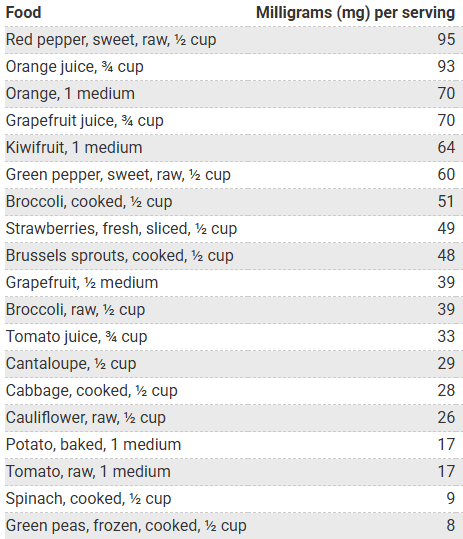
Source: National Institutes of Health Vitamin C Fact Sheet for Health Professionals 8
Deficiency
About 53% of the global population have an inadequate intake of vitamin C 9, but the exact number varies depending on global region. Inadequate intakes were more prevalent in men than women and in areas like South Asia.
Scurvy is a nutritional disorder caused by low vitamin C levels which manifests with varied symptoms affecting multiple organ system due to its role in connective tissue synthesis. Although it is rarely seen, sporadic cases still occur. In developed countries, it is mainly diagnosed in the elderly and malnourished individuals and is associated with alcoholism and poor dietary habit s10.
People who smoke or are exposed to second-hand smoke need more vitamin C in their diets because smoke increases the amount of vitamin C that the body needs to repair damage caused by free radicals 5.
Excess Intakes
In general, vitamin C has low toxicity, and high intakes of vitamin C do not cause serious adverse effects. However, high doses of vitamin C can lead to diarrhoea, nausea, abdominal cramps, and other gastrointestinal disturbances 5.
There are some concerns surrounding high vitamin C intakes, such as the formation of kidney stones and excess iron absorption, but these are not generally considered a risk in healthy individuals. While EFSA did not establish an upper limit, the IoM Tolerable Upper Intake Level for vitamin C ranges from 400 to 2,000mg per day, depending on age 5.
Vitamin C Supplementation
 There is some evidence that vitamin C doses exceeding recommended daily values could have potential benefit. A Cochrane review 11 of clinical trials testing vitamin C’s effect on immune health found that regular supplementation (>200mg per day) did not influence how often participants got common colds but reduced the duration of cold symptoms. A recent meta-analysis 12 of trials which used doses of Vitamin C above 1g per day found a greater benefit on more severe measures of the common cold.
Severe Acute Respiratory Syndrome Coronavirus 2 , which is a respiratory condition, is marked by significant oxidative stress and an excessive inflammatory response that results in tissue damage of the respiratory system. For this reason, there has been interest in combining antioxidants like vitamin C with antiviral and anti-inflammatory treatments to improve patient outcomes. However, a recent review 13 suggests that further trials are necessary to determine optimal doses and conditions of use.
This article was first published in May 2022 and updated on March 24, 2026.
Contributor:
Kerry Health and Nutrition Institute
 We bring the voice of science to some of the most challenging questions facing the food and beverage industry day to day through our network of over 1000 Kerry scientists, external collaborators, and our Scientific Advisory Council.
-
References
- Eggersdorfer M, Berger MM, Calder PC, et al. (2022) Perspective: Role of Micronutrients and Omega-3 Long-Chain Polyunsaturated Fatty Acids for Immune Outcomes of Relevance to Infections in Older Adults-A Narrative Review and Call for Action. Adv Nutr 13: 1415–1430. DOI: 10.1093/advances/nmac058
- InformedHealth.org [Internet]. (2026) Cologne, Germany: Institute for Quality and Efficiency in Health Care (IQWiG); 2006-. In brief: The innate and adaptive immune systems. Available from: https://www.ncbi.nlm.nih.gov/books/NBK279396/. Last accessed March 16, 2026.
- EU Commission. (2012) Commission Regulation (EU) No 432/2012 establishing a list of permitted health claims made on foods, other than those referring to the reduction of disease risk and to children’s development and health. Last accessed March 16, 2026.
- Carr AC, Lykkesfeldt J. (2021) Discrepancies in global vitamin C recommendations: a review of RDA criteria and underlying health perspectives. Crit Rev Food Sci Nutr 61: 742–755. DOI: 10.1080/10408398.2020.1744513.
- Institute of Medicine. (2000) Dietary Reference Intakes for Vitamin C, Vitamin E, Selenium, and Carotenoids. Washington, DC: The National Academies Press. Last accessed March 16, 2026.
- European Food Safety Authority DRV Finder https://multimedia.efsa.europa.eu/drvs/index.htm. Last accessed March 16, 2026.
- Chinese Nutrition Society. (2023) Dietary Reference Intakes for China (2023) -A Summary Report. Last accessed March 16, 2026.
- National Institute of Health. (2025) Vitamin C Fact Sheet for Health Professionals. Last accessed March 16, 2026.
- Passarelli S, Free CM, Shepon A, et al. (2024) Global estimation of dietary micronutrient inadequacies: a modelling analysis. Lancet Glob Health 12: e1590–e1599. DOI: 10.1016/S2214-109X(24)00276-6
- Gandhi M, Elfeky O, Ertugrul H, et al. (2023) Scurvy: Rediscovering a Forgotten Disease. Diseases 11(2), 78. DOI: 10.3390/diseases11020078
- Hemilä H, Chalker E. (2013) Vitamin C for preventing and treating the common cold. Cochrane Database Sys Rev 1: CD000980. DOI: 10.1002/14651858.CD000980.pub4
- Hemilä H, Chalker E. (2023) Vitamin C reduces the severity of common colds: a meta-analysis. BMC Public Health 23: 2468. DOI: 10.1186/s12889-023-17229-8
- Sanduzzi Zamparelli S, Sanduzzi Zamparelli A, Bocchino M. (2025) Immune-Boosting and Antiviral Effects of Antioxidants in COVID-19 Pneumonia: A Therapeutic Perspective. Life (Basel) 15: 113. DOI: 10.3390/life15010113