What is the Role of Vitamin D in Human Health?
Vitamin D, sometimes known as ‘the sunshine vitamin’, is a fat-soluble vitamin important for bone health, muscle function and the immune system1-4. Vitamin D is also being investigated for its role in protecting against some chronic diseases including cardiovascular disease and type-2 diabetes1.
Vitamin D exists in two primary forms:
- vitamin D2 (ergocalciferol) which is obtained from plant and fungi sources that have been exposed to UV light.
- vitamin D3 (cholecalciferol), found in animal-based products such as fatty fish, eggs and liver3.
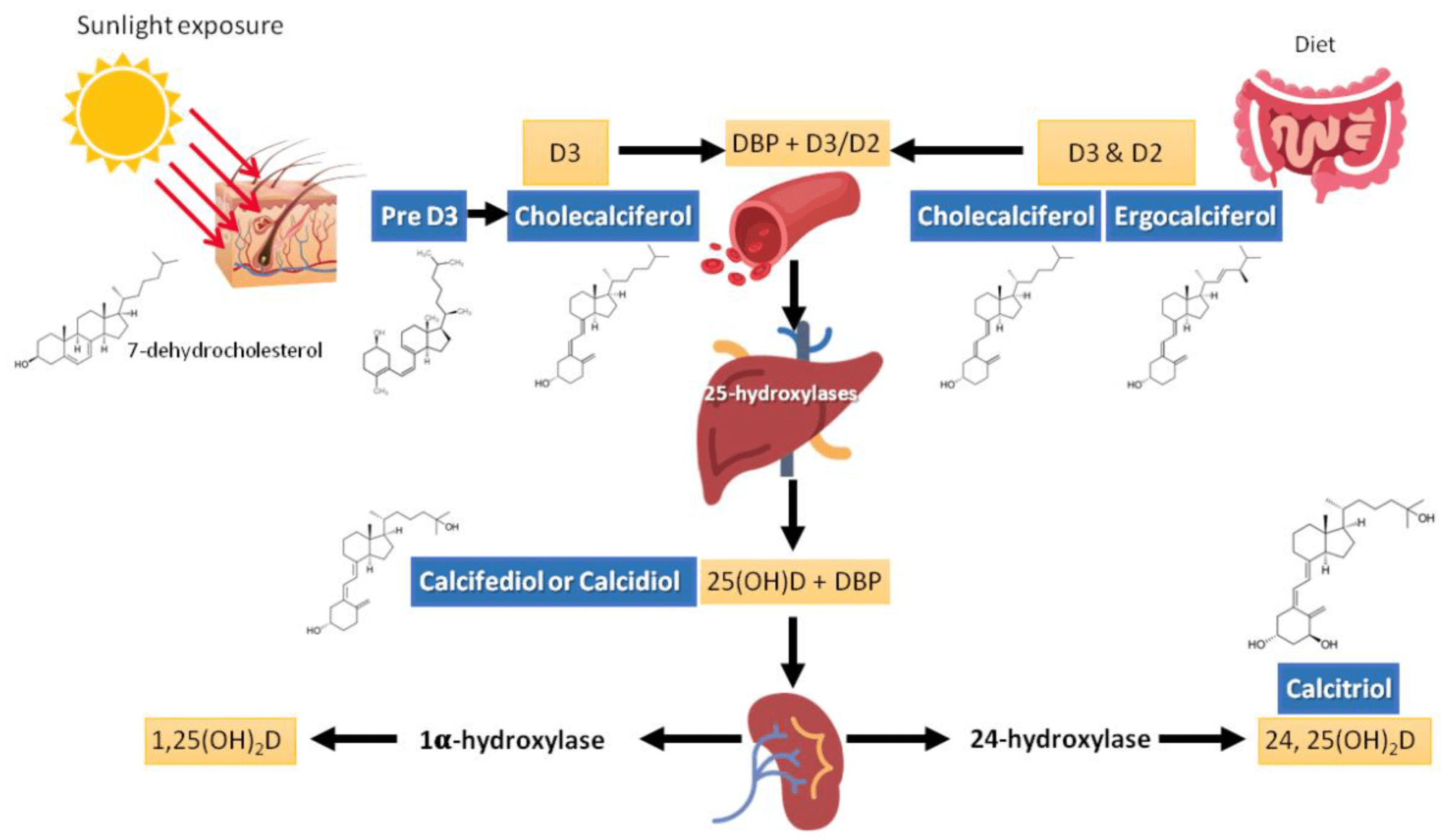
Both forms of vitamin D are biologically inactive when ingested and are absorbed in the small intestine. They are transported to the liver and converted into 25-hydroxyvitamin D (25(OH)D), also known as calcifediol or calcidiol, followed by conversion in the kidneys into 1,25-dihydroxyvitamin D (1, 25(OH)2D), or calcitriol, which is the biologically active form used by the body (Figure 1)3.
Studies have shown that vitamin D3 leads to a greater increase of serum 25(OH)D than vitamin D25.
The ‘sunshine vitamin’ gets its name from the fact that it is also produced in human skin from 7-dehydrocholesterol when exposed to sunlight, or more specifically, UVB rays.
Functions
Research shows that vitamin D plays a significant role in bone health, muscle health and the immune system:
-
- Bone health: Vitamin D is a critical regulator of calcium absorption. In its active form, 1,25(OH)2D, it interacts with the vitamin D receptor (VDR) in the small intestine resulting in an increase in calcium and phosphate absorption2. However, calcium homeostasis is primarily regulated to maintain serum calcium within a narrow range for metabolic reasons with the parathyroid gland, bone, intestine and the kidney working together in this role4. Chronic vitamin D deficiency that results in an increase in parathyroid hormone leads to increased bone resorption, compromising the structure of the skeleton and increasing the risk of fracture thus vitamin D sufficiency is important to optimise skeletal health4.
- Immune health: Vitamin D plays a crucial role in regulating both the innate and adaptive immune responses. The expression of VDR in many different immune cells has been well demonstrated6. It modulates the activity of immune cells such as B cells, T cells and antigen-presenting cells and promotes a balanced immune response. Vitamin D deficiency is associated with an increased risk of hospitalisation for respiratory tract infections7 and supplementation has been shown to boost antigen-specific immunity in older adults with sub-optimal vitamin D status8. Genetic variation in the VDR genes has also been linked to Vitamin D deficiency and the development of autoimmune disease6.
- Muscle function: The identification of a VDR in skeletal muscle cells, along with the strong association between vitamin D deficiency, muscle atrophy and sarcopenia, suggests an important role in muscle function9. Proposed mechanisms include modulation of protein synthesis, mitochondrial metabolism and energy production, which may influence performance. However, the effects of vitamin D3 supplementation on muscle mass, strength and physical performance remain debated, with conflicting findings. Meta-analyses of randomised controlled trials in athletes have not shown conclusive benefits, highlighting the need for further research10,11. In contrast, supplementation has been associated with improved muscle strength in postmenopausal women12. Interpretation of trial results should consider whether populations have insufficient or sufficient vitamin D status and whether any supplementation used has increased 25(OH)D levels sufficiently as these factors may influence outcomes13.
- Mental health: Emerging evidence suggests a link between vitamin D and mental health – its neuroprotective properties may contribute to its role in mental wellbeing, reducing neuroinflammation, supporting serotonin synthesis and improving brain plasticity14. Recent meta-analysis suggests no benefit of supplementation in healthy individuals15 but potential effects on depressive symptoms in those with major depressive disorder or with milder, clinically significant depressive symptoms14. However, more high-quality research trials are needed.
- Other Potential Roles: Vitamin D has other roles in the body, including modulation of cell growth, neuromuscular function and glucose metabolism16. Ongoing research is also exploring the potential benefits on other health conditions including heart disease, diabetes and musculoskeletal diseases like multiple sclerosis17.
In European Union countries, approved health claims are available for the role of Vitamin D in supporting a wide range of functions including maintaining normal bones and teeth, muscle and immune function as well as supporting absorption of calcium and phosphorous subject to conditions.
In China, claims relating to the health of bones and teeth and the absorption and utilisation of calcium and phosphorus are also available for vitamin D containing foods subject to conditions.
Recommended Intakes
In some countries, national dietary reference tables can lag behind updated clinical practice or more recent Vitamin D supplementation policies.
-
- United States: The Institute of Medicine (IOM) Recommended Dietary Allowance (RDA) for vitamin D is 600 IU (15 micrograms) daily for adults aged 19–70 and 800 IU (20 micrograms) daily for adults over 70 years, assuming minimal sun exposure18.
- Europe: The European Food Safety Authority (EFSA) has set an adequate intake at 15 micrograms per day for healthy individuals over one year of age including pregnant and lactating women to ensure the majority of the population will achieve a serum 25(OH)D concentration near or above the target of 50 nmol/L19.
- China: The Chinese Nutrition Society have set a daily Reference Nutrient intake of 400 IU (10 micrograms) for adults aged 18-50 and 600 IU (20 micrograms) for adults over 50 years20.
Dietary Sources
Foods rich in vitamin D include oily fish (e.g., salmon, mackerel and sardines), egg yolks and offal. However, sources are limited and there are high levels of inadequacy of vitamin D intake globally21.
In some countries, fortification of staple food (e.g., milk, margarine, cereals) is used to increase vitamin D intake but these policies differ by region and are often voluntary, leading to variable dietary contributions.
For this reason, local food composition data and values should be used when estimating intakes. For example, milk is frequently quoted as a source of vitamin D but only when vitamin D fortified milk is available.
Liver is a source of vitamin D but is not widely consumed and is not recommended during pregnancy because of its high vitamin A content22.
Among plant-based options, mushrooms exposed to sunlight or UV radiation can supply vitamin D2.
Vitamin D – Beyond Food
The level of 25(OH)D in populations varies geographically due to latitude, skin pigmentation, sun exposure, diet and supplement use.
While endogenous production of vitamin D from sun exposure is also a potential source, recommendations to limit sun exposure to prevent skin cancer and limited sunlight in higher latitudes during winter mean that it cannot be relied upon as a source.

In many countries, vitamin D supplementation is recommended either during winter or throughout the year for more vulnerable populations (e.g. pregnant women, elderly, those with darker skin)23-25.
The Endocrine Society also recommend supplementation for children aged 1 to 18 years and those aged 75 years and older as well as pregnant women and those with high-risk prediabetes26.
Vitamin D Deficiency
The concentration of 25(OH)D in blood serum is currently the main indicator of vitamin D status as it reflects vitamin D produced through both sunlight and from the diet. There is no universal agreement on the threshold for vitamin D ‘deficiency’.
However, there is widespread acknowledgement of vitamin D deficiency using the most conservative 25(OH)D threshold of < 25/30 nmol/L, in both low- and high-income countries1. Depending on the world region, the prevalence of serum 25(OH)D below this threshold ranges from ~5 to 18% and 24 to 49% for levels below 50 nmol/L21.
Vitamin D deficiency in toddlers and young adults can cause rickets and slow brain development. Deficiency in adults causes osteomalacia (brittle bones) increasing susceptibility to fractures.
Confirmed vitamin D deficiency is typically treated with high-dose supplements for a limited number of weeks followed by a maintenance dose28.
Excess Intakes
It is important to remember that as a fat-soluble vitamin, vitamin D can be stored in the liver and excessive amounts should be avoided.
An upper daily limit of 100 micrograms from all sources has been set in the US by the IOM for those 9+ years18 while an upper daily limit of 50 micrograms for children and 100 micrograms for adults has been recommended by the EFSA27.
In Closing
Ongoing research continues to explore vitamin D’s potential benefits further refining our understanding of its role in human health. While vitamin D is essential, further research is needed to fully understand its role in various health conditions and to establish clear guidelines for supplementation.
This article was originally published on March 18, 2025 and updated on March 3, 2026.